

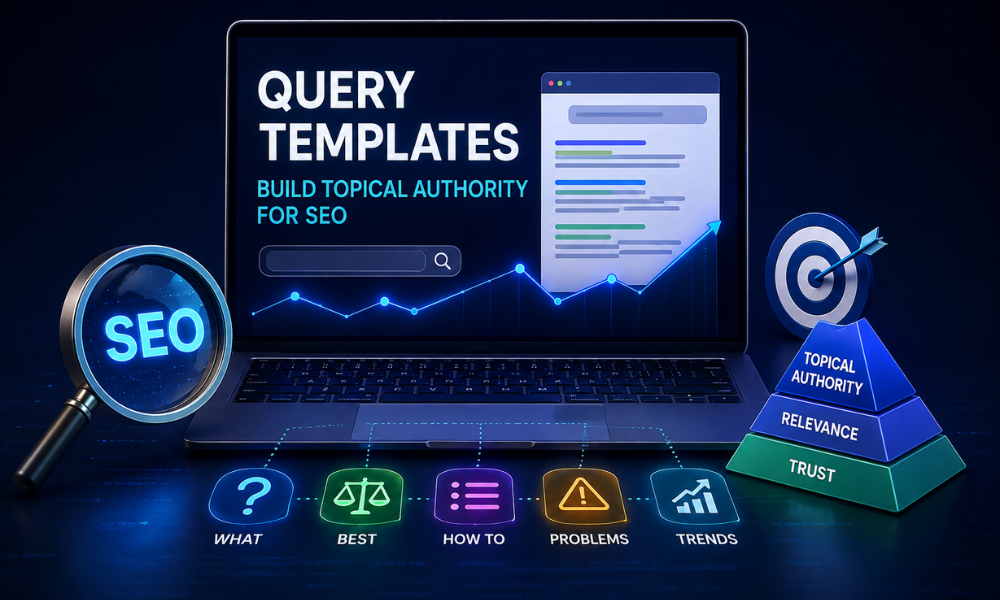
Query Templates: The Secret to Building Topical Authority
Creating SEO content is no longer about choosing a single keyword and repeating it throughout a page. Search engines have become much better at understanding context, search intent, related topics, and the overall depth of a website. This is where query templates can help.
Query templates are common search patterns that people use when looking for information online. Instead of focusing only on one keyword, they help you discover the different questions, comparisons, problems, benefits, examples, and pricing-related searches connected to your main topic.
When these patterns are used correctly, your content can cover a topic from multiple angles and establish stronger topical authority.
What Are Query Templates?
A query template is a repeatable search format that can be applied to different topics.
For example, if your main topic is "SEO tools," users may search:
- What are SEO tools?
- How do SEO tools work?
- What are the benefits of SEO tools?
- Best SEO tools for small businesses
- SEO tools vs Google Search Console
- Examples of SEO tools
- How much do SEO tools cost?
- Problems with SEO tools and their solutions
These searches reveal different types of user intent. Instead of writing one general article, you can use these patterns to identify supporting topics and create more comprehensive content.
Why Query Templates Matter for Topical Authority
Topical authority means demonstrating strong knowledge and coverage of a particular subject. A website that consistently answers relevant questions around a topic can provide more value to users and build stronger relevance in search engines.
Query templates can help you :
- Understand different user search intents
- Discover missing subtopics
- Build comprehensive content clusters
- Improve content relevance and depth
- Find opportunities for additional keywords
- Create stronger internal linking structures
- Support long-term organic visibility
The goal is not to create content simply for the sake of producing more pages. Each piece should answer a genuine search need and contribute to the overall topic.
Common Query Templates for SEO Content
1. Definition Queries
These searches help users understand a topic.
Examples:
- What is [Topic]?
- What does [Topic] mean?
- Why is [Topic] important?
Definition content is particularly useful when your audience may be unfamiliar with a subject.
2. How-To Queries
These searches indicate that the user wants practical guidance.
Examples:
- How to use [Topic]?
- How does [Topic] work?
- How to improve [Topic]?
How-to queries can help you create tutorials, guides, and step-by-step resources.
3. Benefits Queries
Users often search for the advantages of a product, service, strategy, or process.
Examples:
- Benefits of [Topic]
- Why use [Topic]?
- Is [Topic] worth it?
These queries are useful for informational and commercial content.
4. Best and Top Queries
These searches show that users are comparing available options.
Examples:
- Best [Topic] for beginners
- Top [Topic] for businesses
- Best [Topic] in [Location]
This query type is especially valuable for commercial-intent content.
5. Comparison Queries
Comparison searches help users make decisions.
Examples:
- [Topic A] vs [Topic B]
- Difference between [Topic A] and [Topic B]
- Which is better: [Topic A] or [Topic B]?
Comparison pages can capture users who are already considering different solutions.
6. Example Queries
People often want to see real-world applications before taking action.
Examples:
- Examples of [Topic]
- [Topic] examples for businesses
- Real-world examples of [Topic]
Adding practical examples can also make informational content easier to understand.
7. Cost and Price Queries
Pricing is an important part of many buying journeys.
Examples:
- How much does [Topic] cost?
- [Topic] pricing
- Average cost of [Topic]
Addressing pricing-related questions can help attract users with stronger commercial intent.
8. Problem and Solution Queries
Users frequently search when they face a specific problem.
Examples:
- Problems with [Topic]
- Common [Topic] mistakes
- How to fix [Topic] problems
- Solutions for [Topic]
This type of content can position your website as a useful resource rather than simply a promotional website.
How Query Templates Improve Keyword Research
Traditional keyword research often focuses heavily on search volume and individual keyword variations. However, modern SEO requires a broader understanding of what users actually want.
AI Is Changing Keyword Research Forever, making it easier to identify relationships between topics, questions, entities, and search intent. But AI-generated keyword lists should still be reviewed carefully. Search behaviour, business relevance, audience needs, and content quality all matter.
Query templates give your research a structure. Instead of asking only "What keywords should I target?", you can ask:
"What questions would someone have before, during, and after learning about this topic?"
That shift can uncover valuable content opportunities.
Don't Focus Only on Keyword Density
Keyword Density should not be the primary goal when creating comprehensive SEO content.
Repeating a keyword excessively can make content unnatural and reduce readability. Instead, focus on covering the subject properly, using relevant terminology naturally, answering related questions, and satisfying search intent.
A well-structured article may rank for multiple related searches even when those exact phrases are not repeated throughout the page.
How to Find Gaps in My Competitor's SEO Strategy
Analysing My Competitor's SEO Strategy can reveal useful content opportunities.
Start by reviewing competitor pages and identifying:
- Topics they have covered
- Questions they answer
- Questions they have missed
- Comparison content
- How-to guides
- Pricing information
- Examples and case studies
- Supporting articles
- Internal linking opportunities
The objective is not to copy competitors. Instead, identify areas where your website can provide a more complete, accurate, useful, and better-organised answer.
How to Use Query Templates in Your Content Strategy
A simple workflow can make query templates part of your regular SEO process :
- Step 1: Choose your primary topic.
- Step 2: Identify different query patterns such as definition, how-to, benefits, comparison, examples, cost, and problems.
- Step 3: Research the actual questions and variations people use.
- Step 4: Group related queries according to search intent.
- Step 5: Create content that genuinely answers those queries.
- Step 6: Connect related articles using relevant internal links.
- Step 7: Review and update the content as search behaviour and information change.
This approach creates a connected content ecosystem rather than a collection of unrelated blog posts.
The Result : Stronger Topical Authority
When your website consistently covers the important questions surrounding a subject, users can find more of the information they need in one place.
Query templates can help you move beyond basic keyword targeting and build a more complete SEO strategy. By understanding search intent, covering relevant subtopics, analysing competitors, and creating useful content, you can strengthen topical relevance and create better experiences for your audience.
The key takeaway is simple : stop guessing what to write and start understanding what users are actually searching for.
Frequently Asked Questions :
Query templates are common search patterns used to discover different types of questions and search intents around a specific topic.
They help identify related questions, subtopics, comparisons, problems, benefits, and other search intents, allowing a website to cover a subject more comprehensively.
Keyword usage should be natural. Instead of targeting a specific density, focus on search intent, topical coverage, readability, and providing useful information.
AI can help identify related queries, search patterns, topic relationships, and content ideas. However, the results should be reviewed for relevance and accuracy before publishing.
Review competitors' content, keyword coverage, topic clusters, search intent, internal links, FAQs, and missing topics to identify opportunities for better and more complete content.