

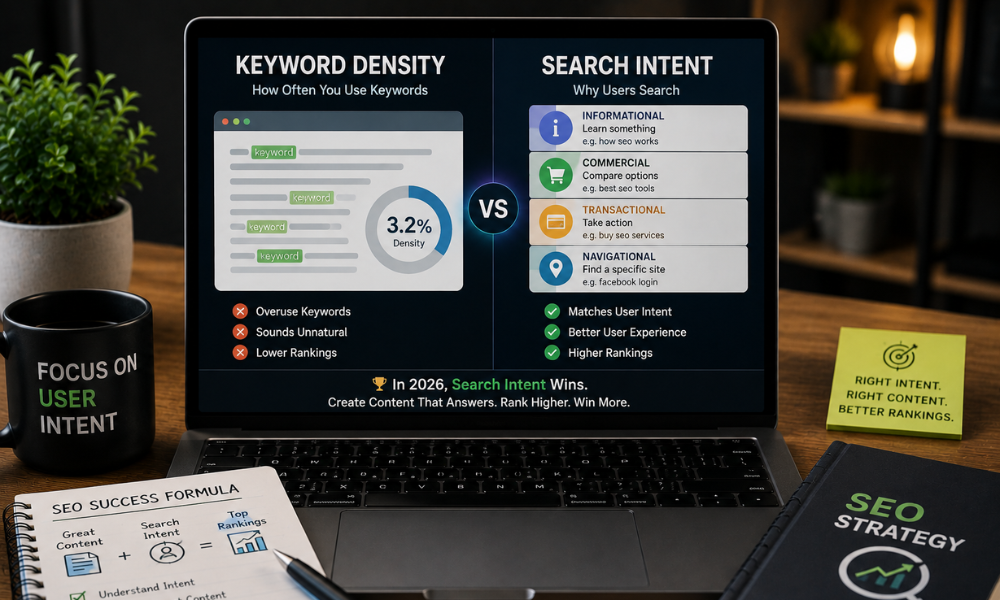
Keyword Density vs Search Intent: What Matters More for SEO in 2026?
SEO has changed a lot over the years. Earlier, marketers often focused heavily on how many times a target keyword appeared on a page. Today, simply repeating a keyword does not make content useful or guarantee better visibility.
For Vijay SEO, the more important question is: does the content actually answer what the user is searching for? This is where search intent becomes more important than chasing a specific keyword density.
What Is Keyword Density?
Keyword density refers to how frequently a particular keyword appears in a piece of content compared with the total number of words.
For example, if a 1,000-word article uses a particular keyword 10 times, its keyword density would be around 1%.
The calculation is simple:
Keyword Density = (Number of Keyword Uses ÷ Total Words) × 100
Keyword density can help writers understand whether a topic is clearly covered, but it should not become the main target of an SEO strategy.
Does a Higher Keyword Density Mean Better Rankings?
Not necessarily.
Using a keyword repeatedly just to increase its frequency can make an article difficult to read. It can also result in awkward sentences and unnecessary repetition.
For example :
“Looking for SEO services? Our SEO services help businesses with SEO. These SEO services are designed for businesses looking for SEO services.”
The keyword appears several times, but the paragraph does not provide much value.
A better approach is to write naturally and cover the topic thoroughly. Related terms, questions, examples, and useful information can help search engines understand the subject without repeating the same phrase again and again.
What Is Search Intent?
Search intent is the reason behind a user's search.
When someone types a query into Google, they usually have a specific goal. They may want information, compare options, find a particular website, or take an action.
The main types of search intent include:
1. Informational Intent
The user wants to learn something.
Examples :
- What is keyword density?
- How does technical SEO work?
- What is search intent?
For these searches, educational and easy-to-understand content is usually appropriate.
2. Navigational Intent
The user is looking for a specific website, brand, or page.
Examples :
- Vijay SEO
- Google Search Console login
- Ahrefs
The user already knows where they want to go.
3. Commercial Investigation
The user is researching options before making a decision.
Examples :
- Best SEO companies in Chennai
- SEO tools comparison
- SEO agency pricing
Comparison guides, reviews, case studies, and detailed service information can work well for this intent.
4. Transactional Intent
The user is ready to take an action.
Examples :
- Hire an SEO agency
- Buy SEO software
- SEO audit service
Landing pages and service pages should clearly address this type of intent.
Why Search Intent Matters More in Modern SEO
Imagine someone searches for “how to improve website rankings.”
They probably don't want a page that simply repeats the phrase “improve website rankings” 30 times.
They want practical information :
- What affects rankings?
- What should they fix first?
- How does content help?
- What technical issues should they check?
- How can they measure progress?
If your content answers these questions clearly, it is much more useful than content created around keyword repetition.
This is why SEO content should start with understanding the user's actual need, rather than deciding how many times a keyword should appear.
Keyword Density vs Search Intent: Which One Should You Prioritize?
If you have to choose between the two, search intent should take priority.
That doesn't mean keywords are no longer important. Keywords still help search engines and users understand what a page is about.
The difference is in how you use them.
Instead of asking :
“How many times should I use my keyword?”
Ask :
“What information is the person looking for, and have I answered it properly?”
That shift can make your content more useful and more natural.
How to Use Keywords Without Keyword Stuffing
You don't need to avoid keywords completely. You simply need to use them where they make sense.
Use the Primary Keyword Naturally
Include your main keyword where it fits naturally, such as :
- Page title
- H1 heading
- Introduction
- Relevant subheadings
- Body content
- Meta title and description where appropriate
Don't force the keyword into every paragraph.
Use Related Terms
Search engines can understand relationships between words and topics.
For an article about search intent, related terms could include :
- user intent
- search queries
- informational intent
- transactional intent
- keyword research
- content relevance
- SEO content
- user experience
These terms help you cover the subject naturally instead of repeating one exact phrase.
Answer Related Questions
Think about the questions users may have after searching for your primary topic.
For example, someone interested in keyword density may also want to know :
- Is keyword density a ranking factor?
- How many keywords should an article have?
- What is keyword stuffing?
- How does search intent affect content?
- How do I optimize content naturally?
Answering these questions can make your article more useful.
What About Keyword Density in 2026?
In 2026, SEO is not simply about matching a keyword a certain number of times.
Search has become more focused on understanding queries, context, relevance, and the usefulness of information. With AI-powered search experiences also becoming part of how people find information, creating content that clearly addresses the user's question is increasingly important.
That doesn't mean keywords have become irrelevant.
They still help communicate the topic of a page. But keyword usage should support the content rather than control it.
A Simple SEO Content Approach for 2026
When creating a new blog, try this process :
- Understand the keyword
Know what the main search term represents. - Identify the search intent
Ask what the user expects to find. - Study the questions around the topic
Look for common problems, comparisons, and follow-up questions. - Build useful content
Give clear answers instead of stretching the article just to increase word count. - Add keywords naturally
Use the main keyword and relevant variations where they genuinely fit. - Improve readability
Use short paragraphs, headings, examples, lists, and clear explanations. - Review the page from a user's perspective
Ask yourself whether the visitor can get the answer without needing to search again.
Keyword density still has a place in SEO as a basic content-writing consideration, but it shouldn't be the goal of your optimization strategy.
Search intent should come first.
When you understand what users want and create content that genuinely answers their questions, keywords can be added naturally without making the article repetitive.
For Vijay SEO, the approach is simple: focus on relevance, clarity, useful information, and the real needs behind a search query. In modern SEO, writing for people first and optimizing intelligently is far more valuable than counting keyword repetitions.
Frequently Asked Questions :
Keyword density can help you review keyword usage, but there is no ideal percentage you need to target. Content relevance and search intent should be the priority.
Search intent is more important because it helps you create content that actually answers what users are looking for.
Google does not provide a recommended keyword-density percentage for ranking pages. Repeating keywords excessively can also make content unnatural.
Keyword stuffing means adding keywords excessively or unnaturally in an attempt to influence search rankings.
There is no fixed number. Use the keyword naturally wherever it helps explain the topic, rather than targeting a specific repetition count.