

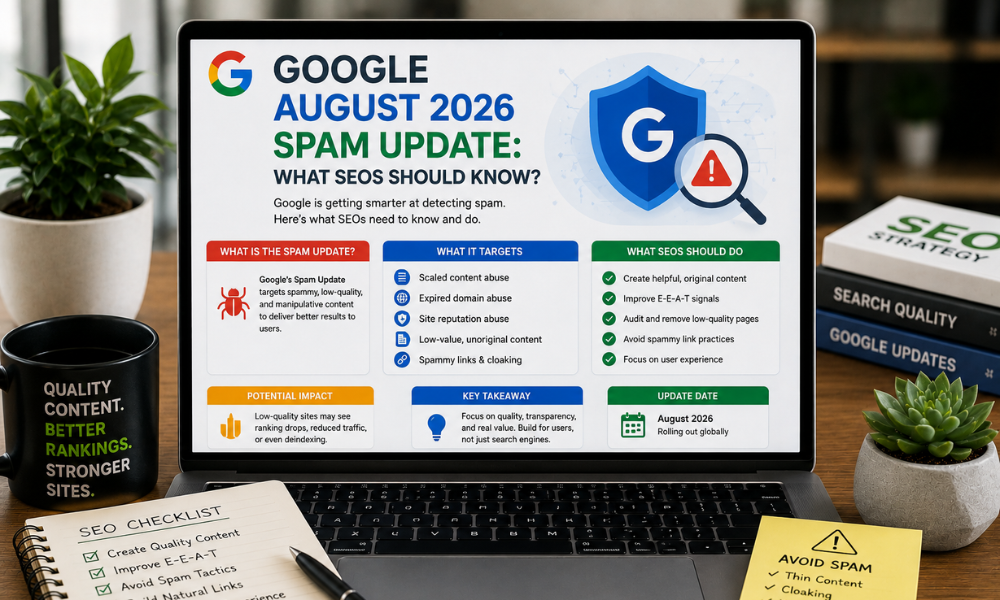
Google August 2026 Spam Update: What SEOs Should Know?
The latest Google Search Update has put website owners and SEO professionals on alert. Google released its August 2026 Spam Update on August 18, 2026, with the rollout expected to take a few days. The update is global and applies across languages and locations.
For website owners, this is a good time to review content quality, SEO practices, backlinks, technical performance, and overall user experience. Rather than making sudden changes because of ranking fluctuations, businesses should use reliable data to identify what actually needs improvement.
What Is the August 2026 Google Spam Update?
Google describes spam updates as improvements to its automated spam-detection systems. These systems are designed to identify websites and content that attempt to manipulate Search rather than provide genuine value to users. Google states that spam-policy violations can result in lower rankings or pages being omitted from Search.
The August update is not a general invitation to rewrite every page on a website. Instead, website owners should examine whether their SEO strategy depends on tactics that could be considered manipulative or low value.
Google's existing spam policies cover areas such as scaled content abuse, cloaking, doorway abuse, scraping, hidden text and links, expired domain abuse, and site reputation abuse.
Content Quality Should Be Your First Priority
One of the most important lessons from any Google Search Update is that useful content remains more important than shortcuts.
Google's guidance recommends creating helpful, reliable, people-first content. Its current guidance also explains that generative AI can be useful for research and organization, but producing large volumes of pages without adding value can fall under scaled content abuse.
Before publishing or updating a page, ask :
- Does the page answer the user's actual question?
- Is the information original and useful?
- Does it demonstrate real expertise or experience?
- Does it provide information that competitors do not?
- Is the content written for people rather than only search engines?
If the answer is no, improving the page should be a priority.
SERP FAQ Removal: What Website Owners Should Know
SERP FAQ Removal is another important change SEO professionals need to understand.
Google officially retired the FAQ rich-result feature from Search in May 2026. Google later removed the FAQ rich-result documentation from its Search documentation updates.
This does not mean FAQ content itself is useless.
FAQs can still help visitors understand products, services, processes, pricing, and common concerns. The important difference is that website owners should not create FAQs simply because they expect FAQ rich snippets in Google.
A useful FAQ section can improve the page experience and answer genuine user questions. However, the content should serve the reader first.
Perform a Content Gap Analysis
A strong Content Gap Analysis can help identify opportunities after a major search update.
Instead of immediately deleting pages that lost traffic, compare your website with competing pages ranking for your target searches.
Look for gaps such as :
- Questions competitors answer that your page ignores
- Important subtopics missing from your content
- Outdated statistics or information
- Weak explanations of complex subjects
- Missing examples or practical advice
- Poor internal linking between related pages
- Search intent differences between your page and ranking results
For example, if your page explains what a service is but competing pages explain pricing, benefits, process, limitations, examples, and frequently asked questions, your page may have a meaningful content gap.
The goal is not to copy competitors. The goal is to identify what users expect and create something more useful and original.
Use AI for Backlink Analysis — But Keep Human Judgment
Another useful strategy is to Use AI for Backlink Analysis.
AI can help SEO teams process large backlink datasets faster. It can categorize links, identify unusual patterns, group referring domains, detect repeated anchor-text patterns, and highlight links that deserve manual review.
However, AI should support backlink analysis rather than automatically decide which links are harmful.
A practical workflow is :
- Export your backlink data from your SEO platform.
- Group links by referring domain and anchor text.
- Identify unusual spikes or irrelevant domains.
- Use AI to classify patterns and prioritize suspicious links.
- Manually review important backlinks.
- Compare backlink changes with ranking and traffic changes.
- Document your findings before taking action.
Google also advises website owners to critically evaluate third-party SEO tools because external tools do not have access to Google's internal ranking data and cannot guarantee ranking improvements.
What Website Owners Should Do After the Update
Do not panic if rankings move during the rollout. Google says the August 2026 Spam Update may take a few days to complete.
Instead, follow a structured review process.
1. Check Google Search Console
Compare clicks, impressions, average position, and affected URLs. Look for changes that continue beyond normal daily fluctuations.
2. Review Low-Quality Pages
Find thin, outdated, duplicated, or pages created primarily for search traffic. Improve them where there is genuine value to add.
3. Audit Your Content Strategy
Check whether AI-assisted content has sufficient original research, experience, examples, and useful insights. AI itself is not the issue; using automation to create unhelpful content at scale can be.
4. Review Your Backlinks
Look for unnatural patterns, irrelevant links, and questionable link-building campaigns. Do not remove legitimate links simply because they look unfamiliar.
5. Improve User Experience
Review mobile usability, navigation, page speed, readability, intrusive elements, and overall website accessibility.
6. Avoid Reactive SEO
A temporary ranking drop does not automatically mean that a page has been penalized. Measure the trend before making major changes.
The August 2026 Google Search Update is a reminder that sustainable SEO depends on usefulness rather than manipulation. Website owners should focus on original content, strong user experience, relevant internal linking, trustworthy information, and a clean backlink profile.
The SERP FAQ Removal also shows why SEO strategies should not depend entirely on one search feature. Meanwhile, Content Gap Analysis can reveal opportunities to improve existing pages, while using AI responsibly can make large-scale backlink analysis more efficient.
The safest approach is simple: understand your data, follow Google's spam policies, improve genuine weaknesses, and build content that deserves to rank.
Frequently Asked Questions :
It is a Google spam update released on August 18, 2026, designed to improve Google's ability to detect spam and search manipulation. The rollout is global and expected to take a few days.
No. The update is designed to target spam-related practices. Websites following Google's Search Essentials and creating useful, people-first content should focus on monitoring performance rather than making unnecessary changes.
Content Gap Analysis identifies useful topics, questions, subtopics, and information that competing pages cover but your website may be missing. It can help guide meaningful content improvements.
Not automatically. First determine whether the page has genuine quality, relevance, and search-intent issues. Improve, consolidate, or remove content based on evidence rather than reacting to short-term ranking volatility.
No. Google states that generative AI can be useful for research and content creation. The concern is scaled content created primarily to manipulate Search without providing value to users.