

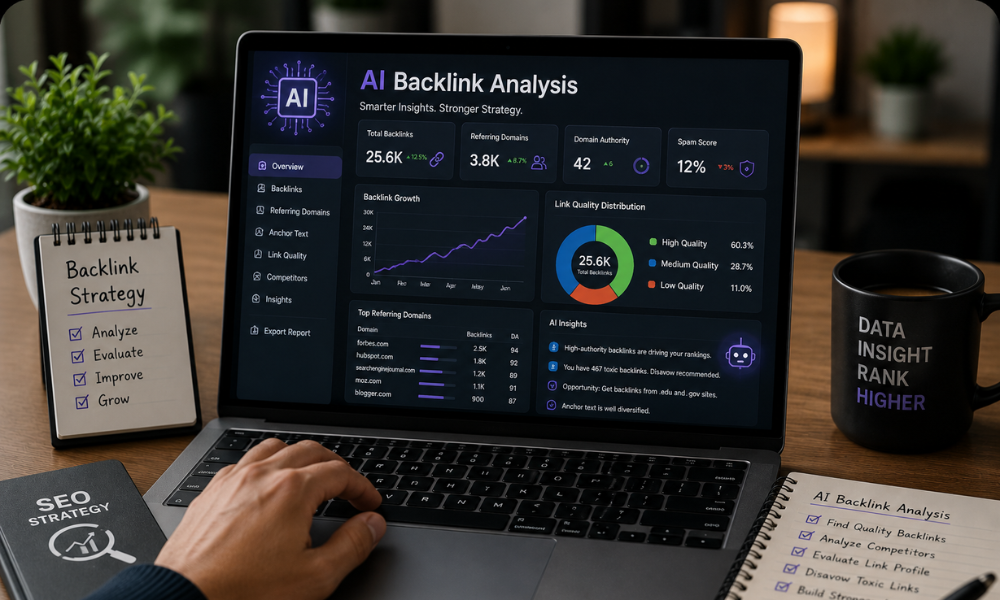
How to Use AI for Backlink Analysis
Backlinks remain an important part of SEO because they can help search engines understand the authority, relevance, and credibility of a website. However, analyzing hundreds or thousands of backlinks manually can take a lot of time. This is where AI for backlink analysis can make the process faster and more organized.
AI can help SEO professionals identify valuable links, detect potentially harmful backlinks, understand competitor link profiles, find link-building opportunities, and prioritize the links that need attention. But AI should not replace SEO judgment. It works best as an analysis and decision-support tool.
What Is Backlink Analysis?
Backlink analysis is the process of examining websites that link to your domain. The goal is to understand the quality of your backlink profile and identify opportunities or problems that could affect your SEO performance.
A backlink analysis normally looks at factors such as:
- Referring domains
- Number of backlinks
- Domain authority or similar quality metrics
- Relevance of linking websites
- Anchor text
- Follow and nofollow attributes
- New and lost backlinks
- Link placement
- Potential spam or low-quality links
- Competitor backlink sources
A website with thousands of backlinks is not automatically stronger than a website with fewer links. The quality, relevance, diversity, and context of those links matter.
Why Use AI for Backlink Analysis?
Traditional AI for backlink analysis backlink analysis can require hours of exporting spreadsheets, sorting URLs, checking domains, and identifying patterns.
AI can speed up repetitive parts of this process.
For example, AI can help you :
Classify backlinks: Group links into categories such as relevant, irrelevant, editorial, directory, guest post, resource page, or potentially suspicious.
Analyze anchor text: Identify overused, branded, exact-match, partial-match, and generic anchor text patterns.
Find patterns: AI can analyze large backlink datasets and highlight trends that may be difficult to notice manually.
Compare competitors: You can analyze competitor backlink data to identify websites linking to competing domains but not to yours.
Prioritize opportunities: Instead of reviewing every backlink individually, AI can help create a shortlist of domains that deserve closer attention.
Step 1: Collect Your Backlink Data
Before using AI, you need reliable backlink data.
Export backlink information from your preferred SEO platform. Depending on the tool, your dataset may contain:
- Linking page URL
- Referring domain
- Target URL
- Anchor text
- Link type
- First-seen date
- Last-seen date
- Domain metrics
- Traffic estimates
- Other available quality signals
Do not blindly upload sensitive website data to an unknown AI platform. Review the platform's privacy and data-handling policies before using it.
The quality of your AI analysis depends heavily on the quality of your input data. If the backlink dataset is incomplete or inaccurate, AI cannot magically fix it.
Step 2: Clean and Organize the Data
Large backlink exports often contain duplicate URLs, multiple links from the same domain, redirected pages, and outdated records.
Clean the dataset before asking AI to analyze it.
For example, you can create columns for :
| Field | Purpose |
|---|---|
| Referring Domain | Identifies the website linking to you |
| Linking Page | Shows the exact page containing the link |
| Target Page | Shows where the backlink points |
| Anchor Text | Helps analyze anchor distribution |
| Link Type | Identifies follow/nofollow or other attributes |
| Relevance | Measures topical connection |
| Quality | Helps prioritize domains |
| Notes | Records manual observations |
This structure makes the analysis much easier.
Step 3: Ask AI to Classify Backlinks
One of the most useful applications of AI is backlink classification.
Instead of manually reviewing every referring domain, you can provide structured backlink data and ask AI to categorize the links.
Useful categories might include :
- High-value relevant backlink
- Relevant industry backlink
- Editorial backlink
- Guest contribution
- Business directory
- Forum/community link
- Irrelevant backlink
- Low-quality website
- Potentially suspicious backlink
- Requires manual review
The important point is that AI classification should be treated as a recommendation, not a final verdict.
A backlink from a low-metric website is not automatically harmful. Likewise, a backlink from a website with impressive metrics is not automatically valuable.
Context matters.
Step 4: Use AI to Analyze Anchor Text
Anchor text gives search engines context about the linked page.
AI can quickly analyze your anchor-text distribution and identify patterns.
For example, it can separate anchors into :
- Brand names
- Naked URLs
- Exact-match keywords
- Partial-match keywords
- Generic phrases
- Long-tail phrases
Suppose most of your backlinks use exactly the same commercial keyword. That may deserve further investigation.
AI can flag the pattern,AI-powered backlink analysis but you still need to evaluate whether the links were naturally earned, intentionally built, or generated through questionable tactics.
The objective is not to force a particular anchor-text percentage. The objective is to understand whether your backlink profile looks natural and relevant.
Step 5: Identify Valuable Linking Domains
Not every backlink has the same SEO value.
AI can help create a priority list by considering multiple signals together.
For example :
High-priority backlink
- Topically relevant website
- Real audience or traffic
- Strong editorial context
- Link points to a useful page
- Natural anchor text
- Credible website
Low-priority backlink
- Unrelated topic
- Thin or low-value content
- Excessive outbound links
- Obviously automated pages
- Repetitive sitewide links
- Suspicious placement
Do not rely on one metric such as Domain Authority alone. Third-party metrics are useful for comparison, but they are not Google's ranking score.
Step 6: Analyze Competitor Backlinks With AI
Competitor backlink analysis is one of the most practical uses of AI.
Collect backlink data for several competing websites and compare their referring domains against yours.
AI can help identify:
- Domains linking to multiple competitors
- Industry publications you have not approached
- Resource pages
- Relevant directories
- Guest contribution opportunities
- Digital PR opportunities
- Content types attracting links
- Frequently linked competitor pages
For example,AI-powered backlink analysis if five competitors have earned backlinks from the same industry publication, that publication could be worth researching.
But do not copy competitors blindly. A competitor's backlink does not automatically mean you should pursue the same link.
AI makes backlink analysis faster by finding patterns, checking link quality, and identifying new opportunities. However, AI should support—not replace—human Vijay SEO judgment. Combine AI insights with manual review to build a stronger, safer backlink strategy.
Frequently Asked Questions :
AI backlink analysis uses artificial intelligence to examine backlink data, identify patterns, classify links, and find SEO opportunities faster.
AI can help analyze anchor text, classify backlinks, compare competitors, identify suspicious patterns, and prioritize valuable link-building opportunities.
AI can flag potentially risky backlinks for review, but SEO professionals should manually evaluate them before removing or disavowing any links.
Yes. AI can compare competitor backlink data and identify common referring domains, content opportunities, and potential websites for link-building outreach.
No. AI is useful for processing data and identifying patterns, but human SEO judgment is still necessary for evaluating relevance, quality, and link-building decisions.