

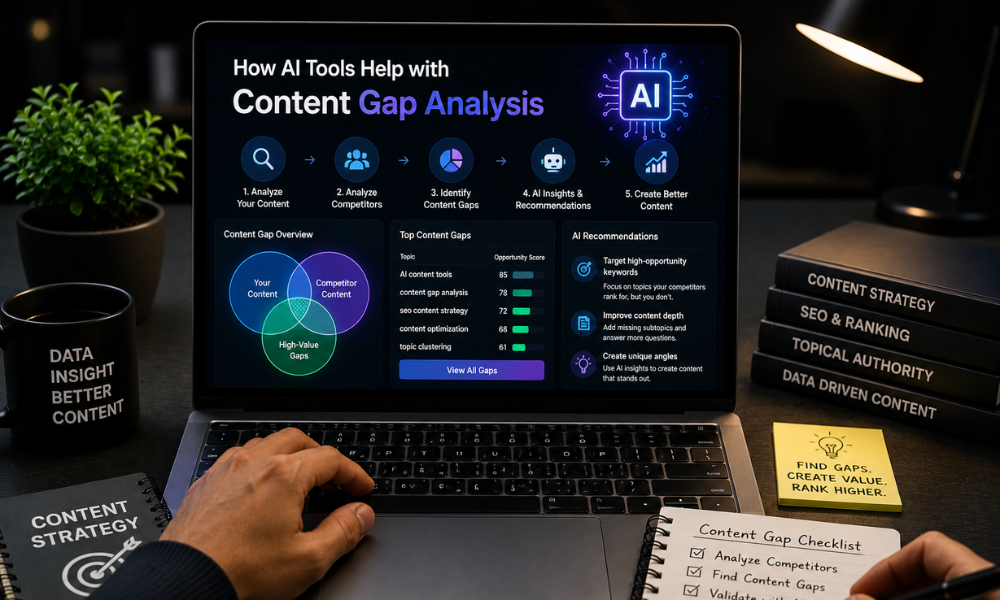
How AI Tools Help with Content Gap Analysis
Creating content consistently is important for any website, but publishing more articles does not always lead to better search visibility.A website may have hundreds of blog posts and still miss important topics that potential customers are searching for. This is where content gap analysis becomes valuable.
Content gap analysis helps identify topics, questions, keywords, and information that are missing from your website compared with competitors or the needs of your target audience. With the development of artificial intelligence, this process has become faster and more detailed. AI tools can analyze large amounts of search and content data, identify patterns, and provide useful insights for building a stronger SEO content strategy.
What Is Content Gap Analysis?
Content gap analysis is the process of finding subjects or search queries that your website does not adequately cover. These gaps may include missing keywords, unanswered customer questions, incomplete topic coverage, or content that is less useful than competing pages.
For example, suppose a website has an article about "SEO for Small Businesses." Competitors may also cover related topics such as local SEO, technical SEO, Google Business Profile optimization, link building, SEO reporting, and common SEO mistakes.
If your website does not cover these related subjects, those areas can represent content gaps.
A proper content gap analysis looks beyond individual keywords. It considers the overall topic and whether your website provides enough useful information to satisfy the searcher's intent.
Why Is Content Gap Analysis Important for SEO?
Search engines aim to provide users with useful and relevant information. Websites that cover a subject comprehensively can have more opportunities to appear for related searches.
Content gap analysis can help businesses :
- Discover topics their audience is interested in
- Identify keywords competitors are targeting
- Find questions that existing content does not answer
- Improve topical coverage
- Develop new blog ideas
- Update outdated content
- Reduce unnecessary content duplication
- Create a more organized content strategy
Instead of creating articles based only on assumptions, businesses can use data to understand where their content needs improvement.
How AI Tools Improve Content Gap Analysis
Traditional content gap analysis can require reviewing competitor pages, keyword lists, search results, and website content manually. This can take considerable time, especially for websites with many pages.
AI tools can help automate parts of this process and make large datasets easier to understand.
1. AI Can Identify Missing Topics
One of the main benefits of AI is its ability to analyze large collections of content and identify related subjects.
For example, if your website focuses on digital marketing, an AI tool can analyze your existing articles and identify related subjects that have not been sufficiently covered.
It may reveal opportunities around :
- Technical SEO
- Local search optimization
- Content optimization
- Search intent
- SEO analytics
- Conversion-focused content
- Voice and conversational search
This gives content teams a broader view of their topic coverage.
2. AI Helps Analyze Competitor Content
Competitor research is an important part of content gap analysis. AI-powered SEO tools can help compare your content with pages that are performing well for relevant search terms.
The analysis may reveal differences in:
- Topics covered
- Subtopics included
- Keyword variations
- Frequently answered questions
- Content depth
- Search intent
- Content structure
The goal is not to copy competitor content. Instead, the information can help you understand what users expect from high-quality pages and identify areas where your own website can provide something more useful.
3. AI Can Discover Related Keywords and Topics
A single keyword rarely represents an entire topic. Users may search for the same information using different phrases.
AI can help identify semantic relationships between keywords and group similar search terms into meaningful topic clusters.
For example, a business targeting "content marketing" may discover related searches involving content strategy, content planning, blog promotion, content distribution, and content performance.
This allows marketers to build content around a complete subject rather than repeatedly targeting one keyword.
4. AI Helps Understand Search Intent
Ranking for a keyword is not enough if the content does not match what the user wants.
Search intent generally describes the reason behind a search. A person may be looking for information, comparing options, finding a specific website, or preparing to make a purchase.
AI tools can analyze search results and content patterns to help identify the likely intent behind keywords.
For example, the keyword "content gap analysis" may have an informational intent, while "content gap analysis tool" could indicate that the user is researching available software.
Understanding these differences helps content creators produce pages that better match user expectations.
5. AI Can Find Questions Your Content Does Not Answer
People often search using questions. These questions can provide excellent opportunities for blog content and FAQs.
AI tools can identify common questions related to a topic and compare them with the questions already answered on your website.
For example, an article about SEO tools may need to answer questions such as:
- What is an SEO content gap?
- How do you perform a content gap analysis?
- Which tools can identify content gaps?
- How often should content gaps be reviewed?
Adding genuinely useful answers can make a page more comprehensive and helpful.
AI Content Gap Analysis and Content Updating
Content gap analysis is not only useful for finding new blog topics. It can also help improve existing pages.
An older article may still receive traffic but fail to cover newer developments or related questions. AI-assisted analysis can highlight areas where the content may need additional information.
Content updates may include :
- Adding missing sections
- Improving outdated information
- Answering new user questions
- Adding relevant examples
- Improving internal links
- Strengthening topic coverage
- Removing unnecessary or repetitive information
Regular content reviews can help maintain the usefulness and relevance of important website pages.
How to Use AI for a Better Content Gap Strategy
AI should support your SEO process rather than completely replace human judgment.
A practical workflow can look like this:
Step 1: Review your existing content
Create an inventory of your important website pages and identify the topics they already cover.
Step 2: Analyze competitors
Study competing websites that have strong visibility for your target topics. Look for subjects and questions they cover that your website does not.
Step 3: Use AI to organize the information
AI can help group related keywords, topics, questions, and content ideas into categories.
Step 4: Check search intent
Review the actual search results and determine what users expect to find for each important topic.
Step 5: Prioritize the gaps
Not every missing topic deserves a new article. Prioritize opportunities based on relevance, business value, search demand, competition, and the quality of your existing coverage.
Step 6: Create useful content
Develop original content that provides genuine value instead of simply reproducing information already available elsewhere.
Step 7: Measure performance
After publishing or updating content, monitor rankings, organic traffic, engagement, and conversions. Use the results to improve your future content strategy.
Why Human Expertise Still Matters
AI can process information quickly, but it does not automatically understand every business, audience, or customer journey.
Human review is important when deciding :
- Which topics are relevant to the business
- Whether information is accurate
- What customers actually need
- Which content opportunities have commercial value
- How a brand should communicate
- Whether an article provides genuine value
AI-generated recommendations should therefore be treated as insights rather than instructions that must be followed without review.
Avoiding Low-Quality AI Content
Using AI for content gap analysis does not mean producing large quantities of automatically generated articles.
Publishing repetitive, shallow, or inaccurate content can create a poor experience for visitors. A better approach is to use AI for research, organization, comparison, and idea generation while ensuring the final content is reviewed and improved by people.
Every article should have a clear purpose, accurate information, original value, and a structure that makes it easy for readers to find what they need.
Conclusion
AI tools are making content gap analysis more efficient by helping marketers identify missing topics, related keywords, competitor coverage, search intent, and unanswered questions. These insights can support a more focused and effective SEO content strategy.
However, AI should be used as a supporting technology rather than a replacement for human expertise. The strongest results come from combining AI-driven research with careful competitor analysis, audience understanding, original ideas, and high-quality writing.
By regularly identifying and addressing content gaps, businesses can build stronger topical coverage, create more useful resources, and develop a website that better meets the needs of both search engines and real users.
Frequently Asked Questions :
Content gap analysis is the process of identifying important topics, keywords, questions, or information that are missing or insufficiently covered on a website compared with competitors or audience needs.
AI tools can analyze large amounts of content and keyword information to identify missing topics, related keywords, competitor content patterns, search intent, and questions that existing pages may not answer.
No. AI can make research and analysis faster, but human expertise is still needed to evaluate relevance, accuracy, business value, audience needs, and content quality.
There is no single schedule for every website. A content gap review can be performed periodically, especially when competitors change their strategies, search behavior evolves, or important website content becomes outdated.
Addressing relevant content gaps can improve a website's topical coverage and usefulness, which may create additional opportunities to rank. However, rankings depend on many factors, including content quality, relevance, technical SEO, competition, authority, and search intent.