

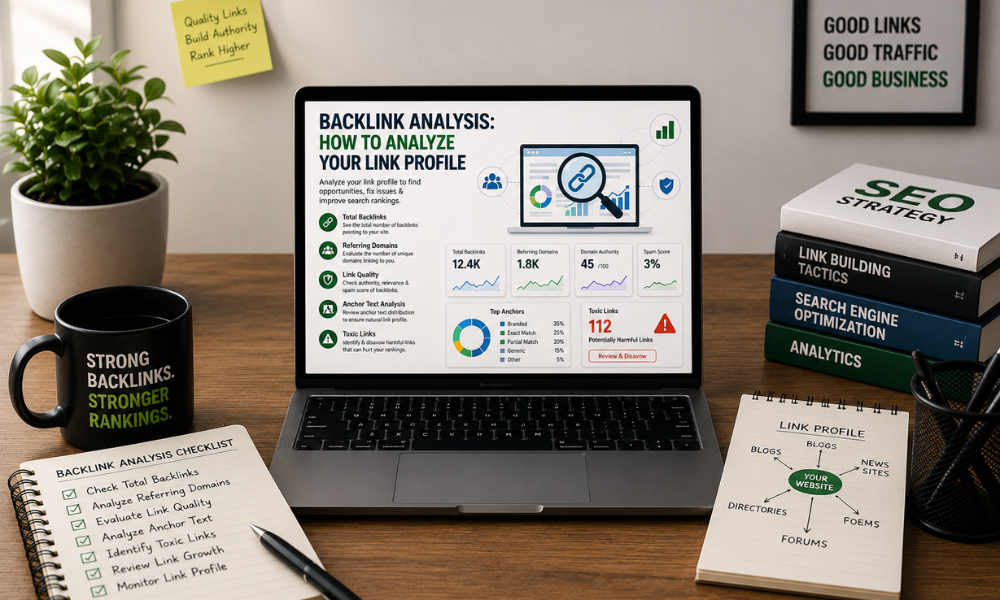
Backlink Analysis: How to Analyze Your Link Profile
A strong website does not depend only on great content and technical SEO. The quality of websites linking to your pages also plays an important role. Backlink Analysis helps you understand where your backlinks come from, which links are valuable, which ones may be risky, and how your overall link profile affects organic visibility. Regular analysis can also help identify problems behind a Sudden Google Ranking Drop.
What Is Backlink Analysis?
Backlink analysis is the process of reviewing all the external links pointing to your website. It gives you a clear picture of your website's link profile and helps you understand whether your off-page SEO strategy is working.
A useful backlink review looks at :
- Total number of backlinks
- Referring domains
- Follow and nofollow links
- Link authority and relevance
- Anchor text distribution
- New and lost backlinks
- Potentially toxic or spammy links
- Links pointing to important website pages
Simply having thousands of backlinks does not automatically mean better rankings. Relevance, quality, trust, and natural link growth matter much more.
Why Is Backlink Analysis Important for SEO?
Backlinks can influence how search engines discover, evaluate, and understand your website. However, a large backlink profile can become difficult to manage without regular monitoring.
A proper review helps you :
Find High-Quality Links
Identify websites that consistently provide valuable and relevant backlinks. These relationships can become useful for future digital PR, content promotion, and link-building campaigns.
Identify Toxic or Suspicious Links
Not every backlink deserves attention from your SEO strategy. Links from irrelevant, spam-heavy, hacked, or low-quality websites may require investigation.
Understand Competitor Link Strategies
Reviewing competitor backlinks can reveal websites, publications, directories, and content resources that are relevant to your industry.
Detect Ranking Problems
If your website experiences a Sudden Google Ranking Drop, checking recent backlink changes should be part of the investigation. Look for lost authoritative links, unusual new links, significant anchor-text changes, or other SEO issues happening around the same period.
How to Perform a Backlink Analysis
A practical backlink review can be completed through several steps.
1. Check Your Total Backlinks
Start by checking the total number of backlinks and referring domains. Don't focus only on the backlink count. A website with fewer links from strong, relevant domains can have a healthier profile than one with thousands of low-quality links.
2. Review Referring Domains
Look at the websites sending backlinks to you. Check whether they are relevant to your industry, legitimate, and capable of providing real value to users.
3. Analyze Anchor Text
Anchor text should appear natural. If a large percentage of your backlinks use the exact same commercial keyword, it may deserve closer attention.
A healthy profile usually contains a natural mix of branded terms, URLs, generic phrases, and relevant keyword variations.
4. Check New and Lost Backlinks
Monitor links gained and lost over time. Losing one low-quality backlink may not matter, but losing several valuable referring domains could affect your SEO performance.
5. Identify Risky Links
Investigate backlinks that appear unnatural, irrelevant, or clearly spam-driven. Avoid removing or disavowing links simply because a tool gives them a low score. Manual evaluation and context are important.
Using AI for Backlink Analysis
AI can make large backlink datasets easier to review. Instead of manually checking thousands of URLs, AI-powered SEO workflows can help categorize links based on relevance, anchor text, domain patterns, and other signals.
AI can assist with :
- Grouping backlinks by topic or domain type
- Finding unusual patterns
- Comparing competitor link profiles
- Identifying repeated anchor-text patterns
- Prioritizing backlinks for manual review
However, AI should support SEO judgment rather than replace it. A backlink should not automatically be considered harmful simply because an automated system assigns it a low-quality score.
Backlink Penalties and Ranking Drops
SEO professionals should also stay aware of the possible Return of Backlink Penalties as search engines continue improving their ability to identify manipulative link practices.
If rankings suddenly decline, don't immediately assume backlinks are responsible. Review technical SEO, content changes, search intent, indexing, algorithm updates, competitors, and backlink changes together.
If you discover a genuine link-related issue, focus on cleaning up manipulative practices and building a more natural profile instead of trying to create hundreds of new links quickly.
Follow an Effective Off-Page SEO Guide
Backlink analysis should be part of your wider Off-Page SEO Guide rather than a one-time task.
A sustainable strategy includes :
- Creating content people genuinely want to reference
- Building relevant industry relationships
- Earning editorial mentions
- Monitoring competitor backlinks
- Tracking new and lost links
- Reviewing anchor-text patterns
- Checking referring-domain quality regularly
The goal is not simply to collect more backlinks. The goal is to build a trustworthy link profile that supports your website's authority and long-term organic growth.
Backlink Analysis gives you valuable insight into one of the most important parts of off-page SEO. By reviewing referring domains, link quality, anchor text, new and lost backlinks, and suspicious patterns, you can make better decisions about your SEO strategy.
Regular monitoring is especially useful when you notice ranking fluctuations or a Sudden Google Ranking Drop. Combined with quality content and a strong technical foundation, a healthy backlink profile can support sustainable search visibility.
Frequently Asked Questions :
Backlink analysis is the process of reviewing external links pointing to a website to understand their quality, relevance, authority, and potential SEO impact.
For an actively growing website, reviewing backlinks monthly is a practical approach. Larger websites or websites experiencing ranking changes may benefit from more frequent monitoring.
Backlinks can be one factor, particularly when there are significant changes or evidence of manipulative link activity. However, technical SEO, content quality, algorithm changes, and competition should also be investigated.
No. A third-party tool's "toxic" label does not automatically mean a backlink is harmful. Evaluate the source, context, relevance, and nature of the link before deciding what action is appropriate.
Anchor text helps search engines understand the context of a link. Reviewing anchor-text diversity can help identify unnatural patterns and maintain a more balanced backlink profile.