

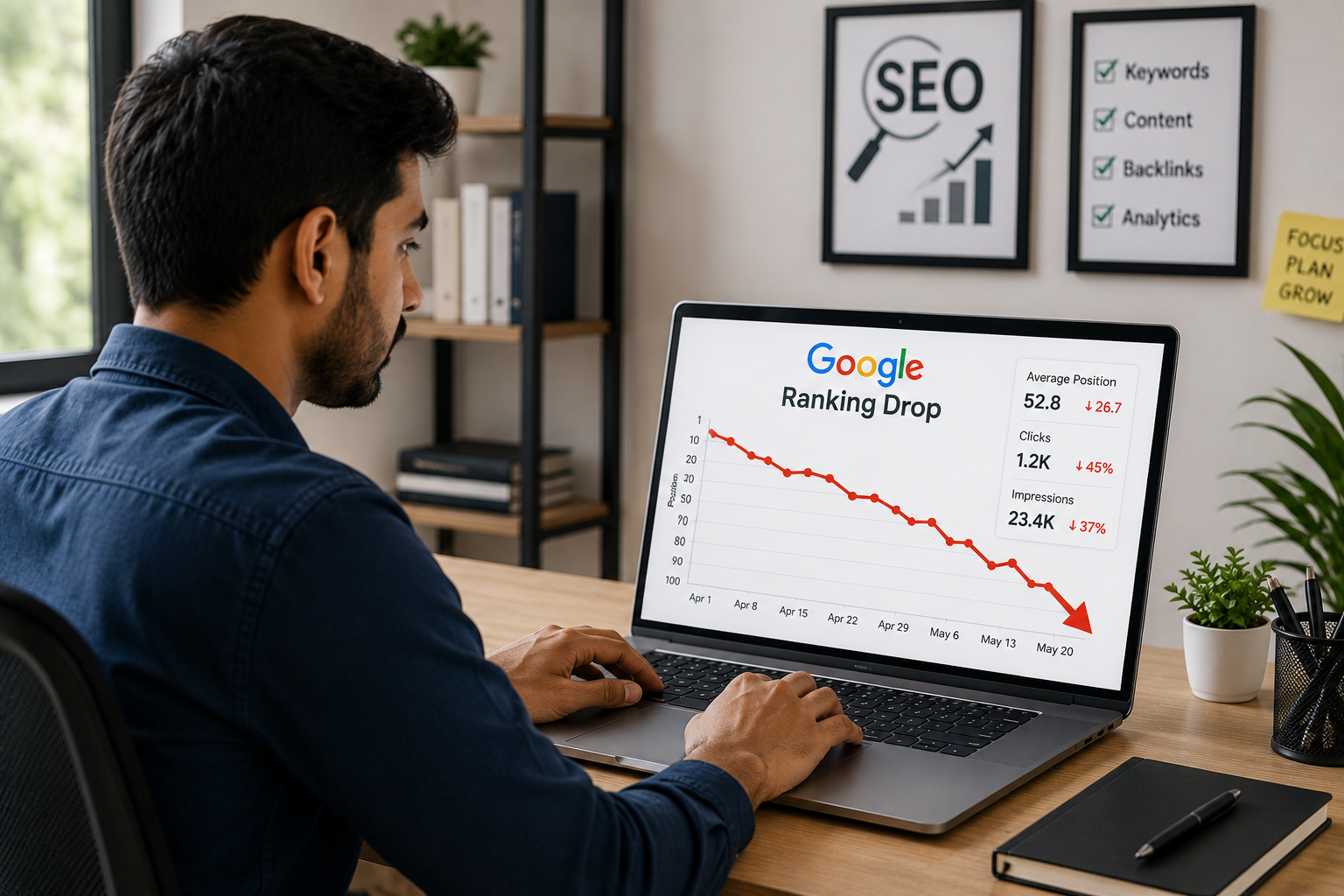
The Most Common Reasons for a Sudden Google Ranking Drop
Seeing your website suddenly lose its Google rankings can be frustrating. One day your pages are performing well, and the next, organic traffic begins to decline without any obvious warning. A sudden Google ranking drop does not always mean your SEO strategy has failed — in many cases it's the result of technical issues, a Google algorithm update, stronger competition, or recent changes made to your own website.
At Vijay Digital India PVT LTD, we've seen that recovering lost rankings starts with identifying the real cause instead of making random SEO changes. The sooner you find the issue behind your ranking drop, the faster you can restore your website's visibility and organic search traffic.
Google Algorithm Updates
Google releases several algorithm updates every year to improve search quality, and each one can trigger a sudden ranking drop across the web. Some updates target content quality, while others focus on spam, user experience, or overall website trust.
If your rankings fell shortly after a known update, compare the timing against official Google announcements or industry reports before making changes.
What to check :
- Recent Google Core Updates
- Helpful Content Updates
- Spam Updates
- Product Reviews Updates
- Search Quality changes
Search is also shifting toward AI-driven results, which is changing what "ranking well" even means. Our breakdown of the top SEO trends every marketer should know in 2026 covers how AI search and EEAT are reshaping visibility beyond traditional rankings. Instead of chasing shortcuts, focus on improving your website against Google's quality guidelines.
Thin or Low-Quality Content
One of the biggest reasons for ranking loss is publishing content that offers little real value to users. Pages with outdated information, duplicate text, or shallow explanations tend to lose visibility over time.
Improve your content by :
- Answering user questions clearly
- Adding original insights
- Updating outdated information
- Including relevant examples
- Improving readability
Helpful content keeps visitors engaged and sends positive quality signals to Google — the same signal Google is now trying to detect through structured data. That's part of why FAQ and Article schema are becoming more important even as some rich results shrink; see our guide on SERP FAQ removal and why schema markup still matters for AI search for the full picture.
Technical SEO Problems
Technical issues can quietly prevent Google from crawling and indexing your pages correctly. Even one small mistake can affect rankings across multiple URLs at once.
Common technical problems include :
- Broken internal links
- Crawl errors
- Incorrect robots.txt settings
- Noindex tags added by accident
- Slow page speed
- Mobile usability issues
- Server downtime
Regular technical SEO audits help you catch these issues before they cause a website ranking drop.
Website Redesign Without SEO Planning
Many businesses redesign their websites without factoring in SEO. Changing URLs, removing pages, or altering site structure without proper redirects is one of the most common causes of a sudden Google search ranking drop.
Before launching a redesigned website :
- Set up 301 redirects
- Preserve important URLs
- Update internal links
- Submit a new XML sitemap
- Test crawlability
Planning ahead protects the rankings you've already earned.
Stronger Competition
Sometimes your rankings drop even though nothing is technically wrong with your website — your competitors are simply outperforming you. Competitors constantly publish new content, tighten their technical SEO, and build stronger backlink profiles.
Monitor your competitors regularly by checking :
- New content
- Updated pages
- Keyword targeting
- Backlink growth
- User experience improvements
We put this into practice ourselves — read what we learned after analyzing a competitor's SEO strategy for a first-hand look at the small, consistent habits that separate top-ranking sites from the rest. SEO is an ongoing process, and maintaining rankings requires continuous improvement.
Loss of High-Quality Backlinks
Backlinks remain one of Google's most important ranking signals. If your website loses valuable backlinks, its authority — and its rankings — can decline.
Possible reasons include :
- Deleted linking pages
- Website closures
- Broken backlinks
- Competitor link acquisition
- Link removal requests
Monitor your backlink profile regularly and keep earning quality links through valuable content and digital PR. If your link profile has weakened, our complete off-page SEO guide to building website authority walks through white-hat backlink strategies you can use to rebuild it.
Poor User Experience
Google evaluates how real users interact with your website. If visitors leave quickly because pages are hard to navigate or slow to load, rankings can suffer over time.
Improve user experience by :
- Increasing page speed
- Making navigation simple
- Using responsive design
- Reducing intrusive pop-ups
- Creating easy-to-read layouts
A positive user experience encourages visitors to stay longer and explore more of your site.
Keyword Cannibalization
Sometimes multiple pages on the same site target the same keyword, causing them to compete against each other. This confuses search engines and weakens overall ranking potential.
To fix keyword cannibalization :
- Combine similar pages
- Optimize one primary page
- Improve internal linking
- Use unique keyword targets per page
Each important keyword should ideally have one dedicated landing page.
Outdated Content
Google favors fresh, relevant information — especially for topics that change frequently. Pages that haven't been updated in years often lose ground to newer content.
Refresh your content by :
- Updating statistics
- Adding recent examples
- Revising screenshots
- Expanding important sections
- Improving keyword relevance
Regular updates help maintain your website's authority and recover lost organic traffic.
Indexing Problems
If Google can't index your pages properly, they can disappear from search results entirely.
Check for :
- Index coverage errors
- Removed pages
- Duplicate URLs
- Canonical tag issues
- Sitemap errors
Google Search Console offers valuable insight into indexing problems that need attention.
Poor Internal Linking
Internal links help search engines understand your website's structure while distributing authority between pages.
Best practices include :
- Linking related articles
- Using descriptive anchor text
- Avoiding orphan pages
- Creating logical navigation
- Updating older articles with links to newer content
A strong internal linking strategy — the kind we cover in our competitor SEO analysis breakdown — supports better crawling and more resilient rankings.
Manual Actions or Security Issues
Although less common, Google can apply manual actions if a website violates search guidelines. Malware or hacked pages can also cause a sudden ranking decline.
Regularly monitor :
- Google Search Console notifications
- Security reports
- Website malware scans
- Spam pages
- Unauthorized content
Fixing these issues quickly helps restore trust with both users and search engines.
How to Recover From a Google Ranking Drop
Recovering rankings takes patience and careful analysis rather than making unnecessary changes.
A good Google ranking recovery process includes :
- Identify when rankings dropped
- Check for Google algorithm updates
- Review technical SEO health
- Audit content quality
- Analyze competitor performance
- Monitor backlinks
- Improve user experience
- Track keyword performance regularly
Consistent optimization usually produces better long-term results than quick fixes.
A sudden Google ranking drop can happen for many reasons, but it's rarely permanent. Understanding the root cause is the first step toward recovery — whether the issue is technical, content-related, or caused by increased competition, a structured approach will help restore your website's search performance.
SEO is an ongoing investment, not a one-time task. By maintaining high-quality content, monitoring technical health, and adapting to Google's evolving algorithms, you can build a website that keeps performing well over time.
Frequently Asked Questions :
Common reasons include Google algorithm updates, technical SEO issues, poor-quality content, lost backlinks, stronger competitors, or indexing problems.
Start by checking Google Search Console, reviewing technical SEO, improving content quality, fixing indexing issues, and monitoring recent algorithm updates.
Recovery depends on the cause. Technical fixes may show results within weeks, while recovering from a major algorithm update can take several months.
Yes. Changing URLs, removing pages, or failing to implement proper redirects during a redesign can cause significant ranking losses.
A comprehensive SEO audit should be conducted every 3 to 6 months, with regular monitoring of technical issues, content performance, and keyword rankings throughout the year.