

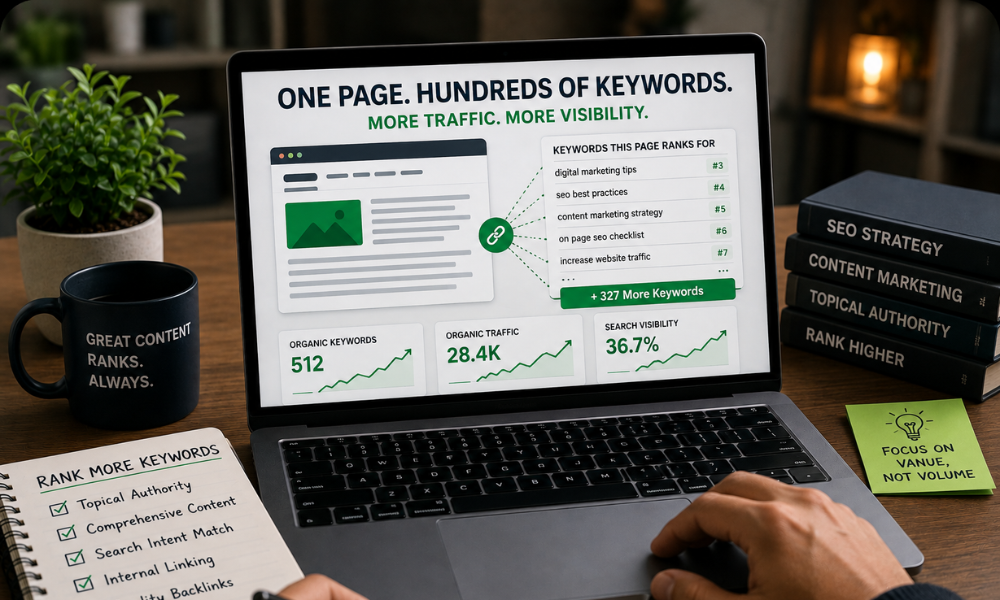
How One Website Page Can Rank for Hundreds of Keywords
A common SEO question is: How can one website page rank for hundreds of keywords? At first, this may seem impossible. Many website owners believe they need to create a separate page for every keyword they want to target. In reality, Google can rank a single high-quality page for many related search terms when the content clearly covers the topic and matches what users are looking for.
This is one of the reasons modern SEO focuses less on repeating exact keywords and more on search intent, topic coverage, relevance, and helpful content.
One Page Can Match Many Search Queries
People rarely search for the same topic using exactly the same words. For example, someone looking for SEO services may search for:
- SEO services
- SEO company
- search engine optimization services
- SEO agency
- professional SEO services
- SEO experts
- website SEO services
These searches are different, but they have a similar purpose. If one page provides useful information around the overall topic, Google may consider it relevant for several of these searches.
This means a page does not necessarily need to target just one keyword. Instead, it can target a main topic and its closely related search queries.
Search Intent Plays a Major Role
Search intent is one of the most important factors behind keyword rankings. Before creating a page, it is useful to understand what users actually want when they search.
For example, searches such as “how does SEO work” usually have informational intent. The user wants to learn something rather than immediately purchase a service.
A page that thoroughly explains how SEO works can potentially rank for related searches such as “SEO process,” “how search engine optimization works,” “SEO basics,” and similar queries.
When the content satisfies the underlying intent, Google has more reasons to show the page for related searches.
Topic Coverage Is More Important Than Keyword Repetition
Older SEO strategies often focused heavily on repeating a target keyword throughout a page. Today, simply adding the same phrase repeatedly does not make content more useful.
Instead, a strong page should cover the important aspects of its main subject.
For example, an article about website SEO could naturally discuss keyword research, technical SEO, content quality, internal linking, backlinks, page experience, search intent, and performance tracking.
By covering these connected areas, the page becomes more comprehensive. It also gives Google more context about what the page is actually about.
Use Related Keywords Naturally
A page ranking for hundreds of keywords does not mean hundreds of keywords were deliberately inserted into the content.
Related phrases usually appear naturally while explaining the subject.
For example, an article about local SEO may naturally include terms such as Google Business Profile, local search results, business reviews, local citations, location-based searches, and map rankings.
These related terms help search engines understand the broader topic without making the content difficult to read.
Long-Form Content Can Create More Ranking Opportunities
Longer content is not automatically better. However, detailed content can provide more opportunities to answer different questions around a topic.
A useful article may answer the primary question and then address related concerns, examples, common mistakes, benefits, processes, and frequently asked questions.
Each useful section can potentially match a different search query.
The key is not to write unnecessarily long articles. The goal should be to provide complete and genuinely useful information.
Internal Linking Can Strengthen Topic Relevance
Internal links can also help search engines understand the relationship between pages on a website.
Suppose a website has a detailed guide about SEO. Other relevant pages about keyword research, technical SEO, content marketing, and local SEO can link to that guide.
These connections create a stronger website structure and help search engines discover and understand related content.
Vijay Digital India PVT LTD focuses on building SEO strategies where content, website structure, and search intent work together rather than treating keywords as isolated terms.
How to Create a Page That Can Rank for Multiple Keywords
Start with one broad topic instead of creating pages for every small keyword variation. Research the questions people ask around that topic and understand the intent behind them.
Then create useful content that answers the main question and naturally covers closely related subjects.
Use a clear heading structure, descriptive page title, relevant internal links, useful examples, and naturally placed keywords. Avoid forcing keywords into sentences where they do not belong.
After publishing, monitor the page in Google Search Console. You may discover that the page is already receiving impressions for keywords you did not specifically target.
Those search queries can provide ideas for improving the page further or creating supporting content.
Key Takeaways
One website page can rank for hundreds of keywords because Google understands topics, context, relationships, and search intent, not just exact keyword matches.
The best approach is to create one genuinely useful page around a clear topic, cover the important related questions, and make the information easy for both users and search engines to understand.
Instead of asking, “How many keywords should I add?”, a better question is, “How completely does this page answer what my audience is searching for?”
Frequently Asked Questions :
Yes. A comprehensive page can rank for hundreds or even thousands of related search queries, depending on the topic, competition, website authority, and content quality.
Yes, when the keywords have closely related search intent. Avoid combining unrelated topics on the same page.
Not necessarily. Keyword stuffing can make content unnatural. Focus on relevance, useful information, and satisfying search intent.
Google Search Console can show the search queries that generate impressions and clicks for a particular page.
Improve topic coverage, answer related questions, use relevant terms naturally, strengthen internal links, and update the page when new useful information becomes available.