
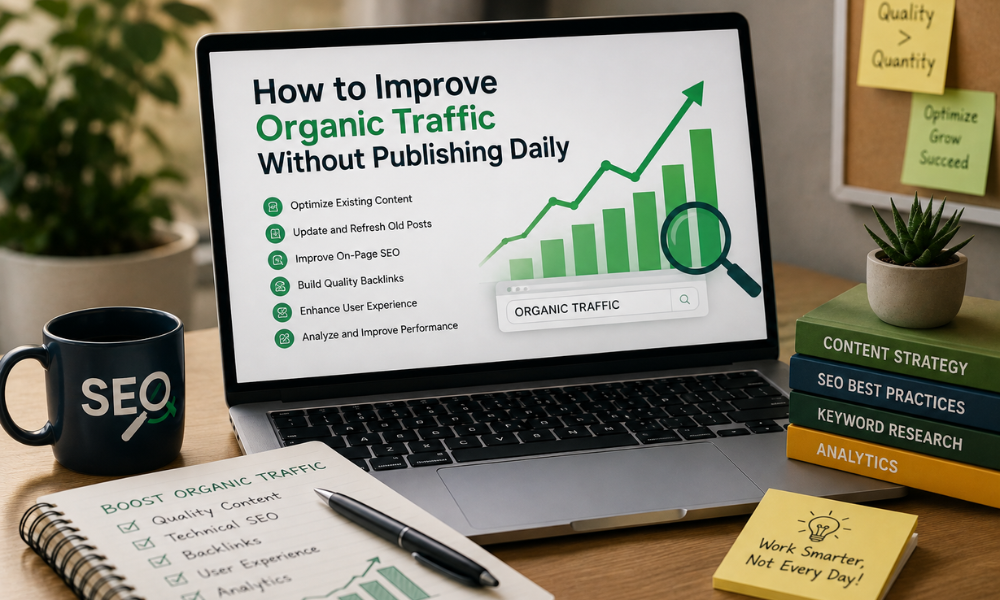
How to Improve Organic Traffic Without Publishing Content Every Day
Many website owners believe they need to publish a new blog post every day to grow organic traffic. The reality is quite different — and chasing publishing frequency alone is one of the most common reasons for a sudden Google ranking drop. Search engines reward high-quality, relevant, and regularly updated content rather than simply rewarding publishing frequency. If your website already has valuable pages, you can significantly improve rankings by optimizing what you already have instead of racing to publish something new every day.
In this guide, we'll walk through 10 proven strategies to improve organic traffic without publishing content daily, and where each one fits into a broader SEO content optimization strategy.
1. Update Your Existing Content Regularly
Google prefers fresh, relevant, and genuinely helpful information over sheer volume. This is directly in line with Google's helpful content update guidelines, which reward pages built around real user value rather than publish frequency.
Instead of writing a new article every day :
- Update outdated statistics
- Add recent examples and data points
- Improve readability and structure
- Expand missing sections and subtopics
- Refresh screenshots and visuals
Updating an old article often produces better SEO results, faster, than publishing a brand-new one from scratch.
2. Target the Right Keywords
Many blogs fail to grow organic traffic because they target keywords with little to no real search intent behind them. Keyword strategy also needs to evolve with the market — see our breakdown of the Top SEO Trends marketers should know in 2026 for what's shifting.
Instead :
- Find keywords your audience is actually searching for
- Add long-tail keyword variations
- Include semantic and related keywords
- Optimize headings around search intent
- Use keywords naturally, never forced
Proper keyword targeting increases your chances of ranking higher for terms that actually convert.
3. Improve Internal Linking
Internal links help both users and search engines discover your most important pages. A well-built site structure — often shaped by the right platform and plugin setup, like when you choose the right SEO plugin for WordPress — makes this far easier to manage at scale.
Best practices :
- Link related articles to each other
- Use descriptive, keyword-rich anchor text
- Connect service pages with relevant blog content
- Regularly audit and fix broken links
Good internal linking distributes ranking authority across your entire website instead of trapping it on one or two pages.
4. Optimize Titles, Headings & Meta Descriptions
Your title tag and meta description directly impact click-through rate (CTR), which is itself a ranking signal. As AI-driven search results reshape the SERP, it's also worth understanding whether rich results and semantic schema markup still matter for visibility.
Ensure :
- Your primary keyword appears in the title
- A compelling, benefit-driven meta description
- Proper H1, H2, and H3 hierarchy
- Clear, engaging, scannable headings
A better CTR compounds over time and can meaningfully improve overall SEO performance — even without adding new content.
5. Create Content That Solves Real Problems
Google increasingly prioritizes genuinely helpful content over content written purely to rank. It's a myth that this favors human writers only — in fact, Google doesn't inherently penalize AI content, as long as it's accurate, original, and useful. The bigger risk is when AI content strategies backfire due to low quality or lack of real expertise.
Include :
- Step-by-step solutions
- Practical, real-world examples
- FAQs that mirror actual user questions
- Case studies and data
- Expert insights and first-hand experience
Helpful content keeps visitors engaged longer, which improves the behavioral signals search engines use to rank pages.
6. Add Visuals, Examples & Practical Tips
Visual content increases engagement and helps explain complex ideas faster than text alone.
Use :
- Infographics
- Screenshots
- Charts and comparison tables
- Videos
- Checklists
Visuals improve user experience, reduce bounce rate, and make content easier to skim — all of which support better rankings.
7. Improve Website Speed & Mobile Experience
Core Web Vitals Optimize:
- Image sizes and formats
- Core Web Vitals (LCP, INP, CLS)
- Browser caching
- Mobile responsiveness
- Lazy loading
Fast, mobile-friendly websites provide a better user experience and consistently rank better than slower competitors.
8. Build High-Quality Backlinks
Quality backlinks remain one of Google's strongest ranking signals — but not all backlinks help. Our complete guide to off-page SEO and website authority covers this in depth, and it's worth also understanding backlink penalties in the AI era before investing in any link-building campaign.
Focus on :
- Guest posting on relevant sites
- Digital PR
- Industry partnerships
- Resource page link building
- Naturally share-worthy content
Avoid spammy, low-quality, or purchased backlinks — they can do more harm than good.
9. Repurpose Existing Content
One blog post can become multiple content formats without any additional research or writing from scratch.
Turn your article into :
- LinkedIn posts
- Facebook posts
- Instagram carousels
- YouTube videos
- Infographics
- Email newsletters
You can then track how that repurposed content performs using Google Search Console's social content tracking.
10. Track Your SEO Performance
You can't improve what you don't measure. Set up your analytics stack correctly — see GTM vs GA4: differences and benefits if you're still deciding between the two — and keep an eye on how Google Analytics' AI Assistant is changing default channel grouping, since it directly affects how your traffic sources are reported.
Monitor :
- Organic traffic
- Keyword rankings
- Click-through rate
- Bounce rate
- Conversion rate
- Top-performing pages
Use tools like Google Search Console and Google Analytics to identify exactly where the next optimization opportunity is hiding.
Don't Forget AI Search Visibility
Organic growth in 2026 isn't limited to traditional Google rankings anymore. Content also needs to be discoverable by AI systems and chatbots. It's worth reviewing how LLMO helps your website get featured in AI search results and our llms.txt guide for AI SEO so your existing content stays visible across both traditional and AI-driven search. If you're planning long-term, our guide to building an AI-first SEO strategy for 2026 is a good next read.
Common Mistakes to Avoid
- Publishing low-quality content frequently
- Ignoring existing blog posts
- Poor internal linking
- Slow-loading pages
- Keyword stuffing
- Duplicate content
- Missing meta descriptions
- Not updating old content
- Ignoring how SERP features like FAQ rich results and AI search schema are changing
Growing organic traffic isn't about publishing every day — it's about making your existing content more valuable, relevant, and discoverable, for both traditional search and AI-Driven Search. By consistently updating content, improving on-page SEO, strengthening internal links, enhancing page speed, earning quality backlinks, and monitoring performance, you can achieve sustainable organic growth with far less effort than creating new content daily.
Frequently Asked Questions :
Yes. Updating existing content, improving SEO, and enhancing user experience can significantly increase organic traffic.
Review and update important articles every 3–6 months, or sooner if information becomes outdated.
Yes. Internal links improve website navigation, distribute page authority, and help search engines crawl your site.
Absolutely. High-quality backlinks remain one of the strongest ranking factors for improving search visibility.
Refresh outdated information, optimize keywords, improve headings, add visuals, strengthen internal links, and enhance page speed.