

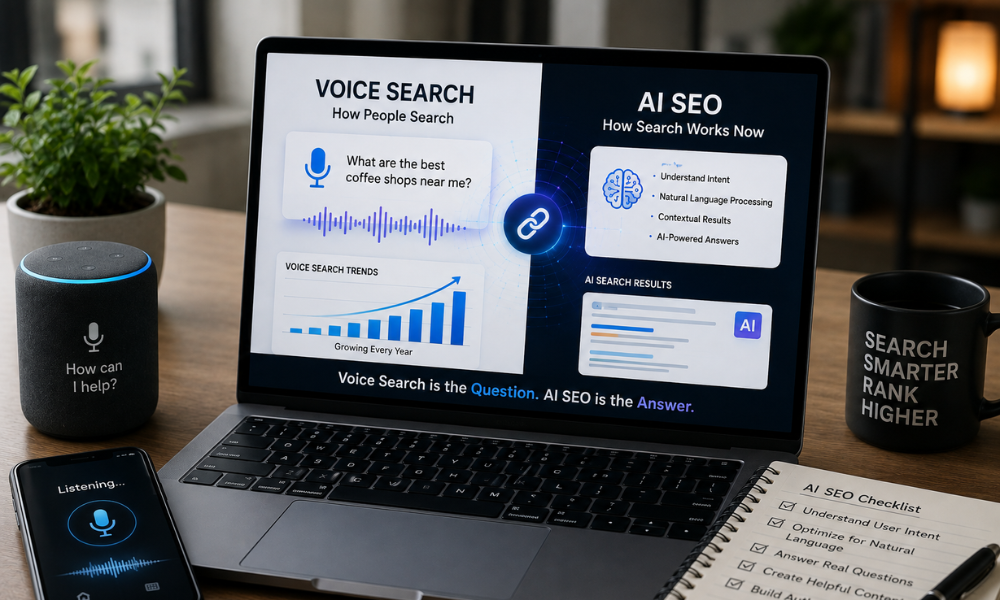
Voice Search and AI SEO: What's the Connection?
Search behaviour has changed more in the last three years than in the previous decade combined. People no longer type stiff, fragmented queries into a search bar — they speak naturally to Alexa, Siri, Google Assistant, and increasingly to AI chat tools like ChatGPT and Gemini. This shift has pulled voice search and AI SEO Strategy into the same conversation, and for good reason: both rely on natural language understanding, context, and intent rather than simple keyword matching. If you're building a website strategy for 2026 and beyond, understanding this connection isn't optional — it's foundational.
Why Voice Search Changed the Rules
Traditional SEO was built around short, clipped keyword phrases — "best running shoes," "plumber near me," "cheap flights Delhi." Voice search flipped that model. When someone speaks to a smart assistant, they ask full questions: "What are the best running shoes for flat feet?"
These queries are longer, more conversational, and packed with intent. Search engines had to evolve to understand not just the words being used, but what the person actually wants. That evolution is powered almost entirely by artificial intelligence — natural language processing (NLP), large language models (LLMs), and machine learning algorithms that interpret context the way a human would.
This is the first thread connecting voice search to the broader world of AI-driven search: both depend on machines understanding language the way people actually use it, not the way marketers used to optimize for it.
The Rise of AI-Powered Search Engines
Search is no longer limited to a list of ten blue links. Google's AI Overviews, Bing Copilot, and AI chat assistants like ChatGPT, Perplexity, and Claude now generate direct, synthesized answers pulled from multiple sources. Voice assistants read these answers aloud. In both cases, the underlying system is an AI model deciding which content is trustworthy, relevant, and well-structured enough to feature.
This is exactly why marketers are shifting from traditional keyword optimization toward a genuine AI SEO approach — one that treats large language models as a primary audience alongside human readers. Ranking well in a classic search results page is no longer the finish line; being selected, quoted, or cited by an AI-generated answer is the new goal.
How Voice Search and AI SEO Are Connected
The connection comes down to three shared priorities:
1. Natural Language Optimization
Both voice search and AI-driven search engines prioritize content written in a conversational, question-and-answer format. Instead of stuffing pages with rigid keywords, successful content answers real questions clearly and directly — the same way a person would explain something to a friend.
2. Structured, Extractable Content
AI systems (and voice assistants pulling from them) favor content that's easy to parse: clear headings, concise answers near the top, bullet points, and well-organized FAQ sections. If an AI model can't quickly extract a clean answer from your page, it will pull the answer from a competitor's site instead.
3. Authority and Trustworthiness
Both systems weigh source credibility heavily. Original data, clear expertise, accurate information, and consistent publishing history all signal to AI crawlers and voice assistants that your content is safe to cite or read aloud.
Building an AI-First SEO Strategy
Adapting to this shift means rethinking your entire approach to content and technical optimization. An AI-First SEO Strategy treats large language models, voice assistants, and AI search engines as primary consumers of your content — not an afterthought layered on top of traditional keyword SEO.
Here's what that looks like in practice:
- Answer questions directly. Structure key pages around real questions your audience asks, with the answer appearing within the first two or three sentences of each section.
- Use conversational language. Write the way people speak, including long-tail and question-based phrases naturally, without forcing keywords into unnatural sentences.
- Prioritize structured data. Schema markup (FAQ, HowTo, Article) helps both traditional search engines and AI crawlers understand your content's structure and intent.
- Optimize for featured snippets. Voice assistants frequently read out featured snippet content, so concise, well-formatted answers increase your odds of being the source that gets spoken aloud.
- Build topical authority. Cover a subject comprehensively across multiple pages rather than chasing isolated keywords, since AI models reward depth and consistency over scattered content.
Understanding LLMs.txt Optimization
Similar in spirit to robots.txt, this file sits at the root of your domain and gives large language models a clean, structured summary of your site — key pages, core content, and context that helps AI systems understand what your website offers without having to crawl and interpret every page from scratch.
LLMs.txt Optimization is quickly becoming a core technical pillar of modern SEO. A well-structured llms.txt file can include:
- A short summary of your website's purpose and expertise
- Links to your most important, authoritative pages
- Clear descriptions of what each linked page covers
- Guidance that helps AI models cite your content accurately
While llms.txt adoption is still evolving and not every AI platform uses it the same way, early movers are positioning themselves to be better understood — and more frequently cited — as AI-driven discovery becomes standard practice across search engines and voice assistants alike.
Practical Steps to Optimize for Both Voice Search and AI SEO
- Audit your existing content for question-based structure. Identify pages that could be reorganized around common customer questions.
- Add or refine FAQ sections using clear, direct language — these are prime real estate for both voice assistant answers and AI-generated summaries.
- Improve page load speed and mobile experience, since voice searches overwhelmingly happen on mobile and smart devices.
- Implement schema markup across product, service, and article pages.
- Create or update your llms.txt file with accurate, concise descriptions of your site's core offerings.
- Monitor how AI platforms reference your brand, adjusting content based on which pages get cited and which don't.
Looking Ahead
Voice search and AI-driven discovery aren't separate trends — they're two expressions of the same underlying shift toward machines understanding language naturally. Websites that adapt now, by combining conversational content, technical readiness, and an AI SEO mindset, will be far better positioned as more search happens through spoken queries and AI assistants rather than typed keywords.
The businesses that treat this as a passing trend will fall behind. The ones that build a genuine AI-first foundation — from content structure to llms.txt files — will be the ones AI systems trust enough to recommend, cite, and read aloud to the next generation of searchers.
Frequently Asked Questions :
Voice search and AI SEO are closely related because both depend on natural-language understanding and search intent. Voice queries are often conversational, making clear and context-rich content particularly valuable.
Create concise answers to common questions, use conversational language, target long-tail queries, improve local SEO where relevant, optimize mobile experience, and organize content with descriptive headings.
No. AI SEO should complement traditional SEO. Technical accessibility, useful content, authority, internal linking, user experience, and other established SEO fundamentals continue to matter.
No. LLMs.txt should not be treated as a mandatory SEO requirement or guaranteed ranking signal. It can be considered an additional technical resource while businesses continue focusing on established SEO practices.
Structured data provides explicit information about elements on a webpage. When implemented correctly and supported by search systems, it can help search engines better understand entities and page content.