

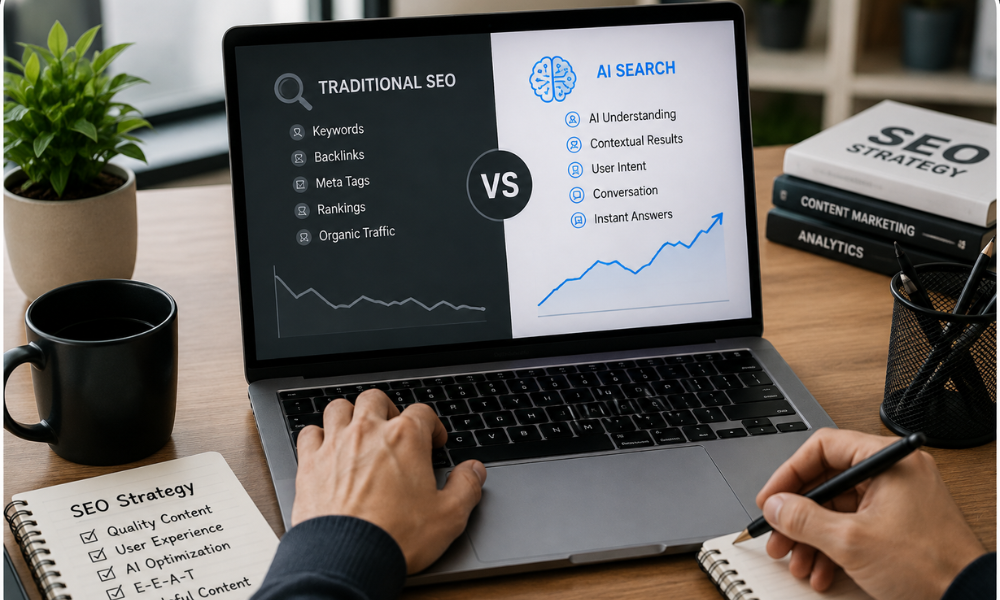
Is Traditional SEO Dead? The Truth About AI Search
"Is SEO dead?" is a question that resurfaces every time search technology changes — and AI-powered search has brought it back louder than ever. With Google AI Overviews, ChatGPT, and Perplexity changing how people find information, many business owners wonder if investing in traditional SEO still makes sense.
Here's the honest, practical answer: Traditional SEO isn't dead — but it is evolving, and businesses that don't adapt will get left behind.
Why People Think Traditional SEO Is Dying
1. AI Overviews Are Reducing Clicks
Google AI Overviews now answer many queries directly on the search page, reducing the need to click through to websites.
2. AI Chatbots Are Becoming Search Alternatives
More users, especially younger audiences, are turning to ChatGPT and similar tools instead of typing queries into Google.
3. Zero-Click Searches Are Rising
A growing percentage of searches end without any website visit at all, as users get their answers directly from AI-generated summaries.
4. Keyword Rankings Feel Less Impactful
Ranking #1 organically doesn't guarantee visibility anymore if an AI Overview appears above it and answers the query directly.
These are real, valid concerns — but they don't mean SEO itself is dead. They mean the definition of SEO success is expanding.
Why Traditional SEO Is Still Very Much Alive
1. AI Models Still Rely on Well-Optimized Websites
AI Overviews and chatbots pull their information from indexed, crawled web content — meaning strong technical SEO and quality content remain essential inputs for AI-generated answers.
2. Backlinks Still Signal Authority
Backlink profiles remain one of the strongest trust signals for both traditional rankings and AI citation eligibility.
3. Technical SEO Still Determines Visibility
Site speed, mobile-friendliness, crawlability, and indexing are foundational requirements — without them, neither traditional search engines nor AI models can properly access your content.
4. Local SEO Remains Critical
Google Business Profile optimization and local search signals are more important than ever, as AI-powered local search increasingly relies on this data.
5. Not All Searches Trigger AI Overviews
Many transactional, branded, and specific searches still show traditional organic results without AI-generated summaries, keeping classic ranking factors highly relevant.
What's Actually Changing: SEO vs AI SEO
| Aspect | Traditional SEO (Still Applies) | New AI Search Requirement |
|---|---|---|
| Technical health | Site speed, mobile-friendliness | Same, plus AI crawler accessibility |
| Content quality | Relevant, keyword-optimized | Answer-first, clearly structured |
| Authority signals | Backlinks, domain authority | Entity trust, E-E-A-T |
| Keyword strategy | Short and long-tail keywords | Conversational, question-based queries |
| Local SEO | Google Business Profile | Same, with AI Overview local integration |
| Success metric | Rankings, organic traffic | Rankings + AI citations + brand mentions |
The core principles of SEO haven't disappeared — they've been extended to account for how AI interprets and presents information.
What Businesses Should Actually Do
1. Keep Investing in Technical SEO
Don't abandon the fundamentals — fast, crawlable, mobile-friendly websites remain essential for any search visibility, traditional or AI-driven.
2. Restructure Content for Clarity
Add clear headings, direct answers, and scannable formatting to help both search engines and AI models extract accurate information.
3. Add Structured Data
Implement schema markup to help AI systems understand your content's context and increase citation potential.
4. Strengthen Authority and Trust Signals
Focus on E-E-A-T, quality backlinks, and consistent business information across the web.
5. Expand Keyword Strategy
Include conversational, question-based phrases alongside traditional keyword targeting.
6. Monitor Both Rankings and AI Visibility
Track traditional keyword rankings alongside whether your content appears in AI Overviews or chatbot responses.
The Real Truth About SEO's "Death"
SEO doesn't die — it transforms. This same conversation happened during:
- The shift from desktop to mobile search
- The introduction of Google's featured snippets
- The rise of voice search and smart assistants
- Multiple major Google algorithm updates over the years
Each time, businesses that adapted their strategy maintained visibility, while those relying on outdated tactics saw declines. AI search is simply the latest — and most significant — evolution in this ongoing pattern.
Frequently Asked Questions :
No. Traditional SEO fundamentals remain the foundation that AI search visibility is built upon. Stopping traditional SEO efforts would hurt both classic rankings and AI citation potential.
It's unlikely in the near term. AI search tools are becoming significant complements to traditional search, but Google and traditional search engines remain dominant for now.
Rather than splitting budget separately, focus on integrating AI SEO best practices — like structured data and clear content formatting — into your existing SEO strategy.
Yes. Backlinks remain a strong authority signal for both traditional search rankings and AI model trust evaluation.
Assuming SEO is either "completely dead" or "unaffected by AI" — both extremes are inaccurate. The realistic approach is adapting existing strategy to include AI-focused optimization.