

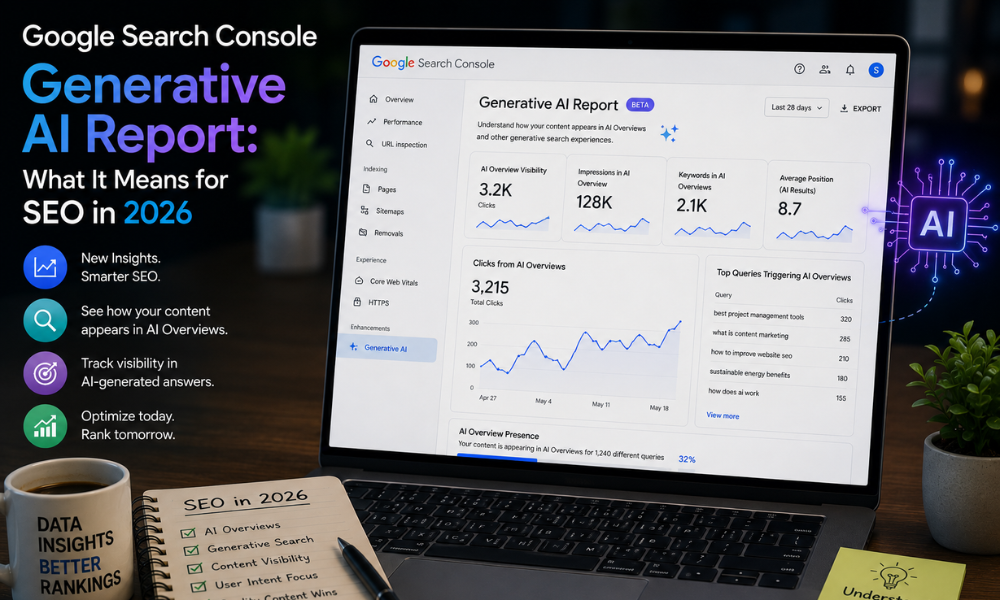
Google Search Console Generative AI Report: What It Means for SEO in 2026
Google Search is rapidly evolving as AI-powered search experiences become a bigger part of how users discover information online. To help website owners understand this changing search landscape, Google has introduced a new Generative AI Performance Report in Google Search Console.
The new report provides dedicated visibility data for generative AI features in Google Search, including AI Overviews and AI Mode. It allows website owners and SEO professionals to understand how often their pages appear in these AI-powered experiences and where that visibility is coming from.
What Is the Google Search Console Generative AI Report?
The Generative AI Performance Report is a new reporting section in Google Search Console designed to measure a website's visibility within Google's generative AI search features.
Previously, SEO professionals mainly relied on traditional metrics such as clicks, impressions, CTR, and average position to evaluate organic search performance. The new report adds a dedicated view for impressions generated through Google's supported generative AI experiences.
Google announced the new reports on June 3, 2026, initially making them available to a subset of websites while the company continues testing and gathering feedback before a wider rollout.
Which Google AI Features Are Included?
The Search Generative AI Performance Report currently includes data from:
- AI Overviews
- AI Mode
Google may expand the list as its generative AI search experiences develop. Search Console does not currently include data from experimental Search Labs features.
This makes the report particularly useful for businesses that want to understand whether their content is being surfaced as a source within Google's AI-powered search experiences.
What Data Does the Report Show?
The report focuses primarily on impressions and allows website owners to analyze their AI visibility using different dimensions.
1. Generative AI Impressions
Impressions show how often links to your website appeared within a generative AI feature on Google Search.
For example, if a page from your website is shown as a supporting link within an AI Overview and meets Google's impression criteria, that visibility can contribute to your reported impressions.
2. Pages
The Pages dimension helps identify which URLs from your website are receiving the most or least visibility in generative AI features.
This can help SEO teams discover:
- Which blog posts are being surfaced
- Which service pages are gaining AI visibility
- Which content topics have stronger potential
- Which pages may need further optimization
3. Countries
You can analyse generative AI impressions by country.
This is especially useful for businesses targeting multiple markets because AI visibility may differ depending on geographic location and search behaviour.
4. Devices
The report can also show whether AI-related impressions are coming from desktop, mobile, or tablet users.
This can help businesses understand how their AI search visibility varies across devices.
5. Dates and Trends
The date dimension allows you to analyse performance over time.
Depending on the selected time granularity, you can examine your data by:
- Day
- Week
- Month
This makes it easier to identify increases, decreases, and longer-term trends in generative AI visibility.
How Is an AI Impression Counted?
Understanding the metric is important before comparing your AI visibility with traditional Search Console data.
Google explains that an impression occurs when a link to your website is shown to a user within a generative AI feature on Google Search.
For AI Overviews, a link must be scrolled or expanded into view to count as an impression. AI Mode follows standard impression rules for its search results.
There can also be differences between the total shown in the chart and the numbers shown in the table because Google aggregates data differently depending on the selected dimension.
Why Is This Update Important for SEO?
The biggest change is that search visibility is no longer limited to traditional Search-Result Rankings.
A website can potentially appear as a source within an AI-generated answer even when users interact differently with the search result page.
This means SEO teams need to start asking additional questions:
- Is our content appearing in AI search experiences?
- Which pages receive AI impressions?
- Which topics generate the most AI visibility?
- Which countries see our content in AI features?
- Is our AI visibility increasing over time?
The new report provides data that can help answer these questions.
Generative AI Report vs Traditional Performance Report
The traditional Search Console Performance Report remains essential for measuring organic search performance. It provides metrics such as clicks, impressions, CTR, and position across Google Search.
The Generative AI Performance Report adds a more focused view of impressions from Google's supported generative AI experiences.
| Traditional Performance Report | Generative AI Performance Report |
|---|---|
| Measures overall Google Search performance | Measures visibility in generative AI features |
| Clicks and impressions | Generative AI impressions |
| CTR | Focuses primarily on impressions |
| Average position | AI-feature visibility |
| Queries, pages, countries and devices | Pages, countries, devices and dates |
| Traditional organic search analysis | AI-powered search visibility analysis |
Both reports should be used together rather than treating the Generative AI report as a replacement for traditional SEO reporting.
How SEO Professionals Can Use the New Report
The report becomes more valuable when the data is connected to an SEO strategy.
Identify Pages With Strong AI Visibility
Start by reviewing the Pages dimension and identifying URLs receiving significant generative AI impressions.
Look for common patterns:
- Content depth
- Search intent
- Topic relevance
- Clear answers
- Strong internal linking
- Helpful supporting information
These patterns can provide useful clues about the types of content being surfaced in AI search.
Find Content With Growth Potential
Pages receiving some AI impressions may represent opportunities for further optimization.
For example, if an important service page is beginning to receive AI visibility, you could strengthen it with:
- Clear service information
- Relevant supporting content
- Strong internal links
- Structured information
- Helpful FAQs
- Original expertise and evidence
The objective should not be to manipulate AI systems, but to make the content genuinely useful and easy to understand.
Compare Countries and Devices
Businesses operating across different markets can use country and device data to identify differences in AI visibility.
For example, a company targeting India, Singapore, and the United States could discover that certain pages receive stronger AI visibility in one market than another.
This can inform future content and localization strategies.
Track Changes Over Time
Do not judge performance from a single day's data.
Instead, monitor trends across longer periods and compare changes against:
- Content updates
- New content publishing
- Technical SEO improvements
- Search algorithm changes
- Changes in user search behavior
This gives you a more meaningful picture of how your website's AI visibility is developing.
What Should You Do If You Don't See the Generative AI Report?
Don't panic if the option is missing from your Google Search Console account.
Google says the report is currently being rolled out to a subset of website owners. A property may also not show the report if it has not received enough impressions in Google's generative AI features.
Therefore, the absence of the report does not necessarily mean that something is wrong with your website.
As Google continues the rollout, more properties may gain access.
Is Generative AI Visibility the Same as Ranking?
No.
AI visibility should not simply be interpreted as a new version of traditional keyword ranking.
AI-powered search experiences can present information differently from conventional search results. In AI Overviews, for example, Google can provide an AI-generated summary with links to supporting web resources.
Therefore, SEO professionals should look beyond rankings and consider a broader concept of search visibility.
How This Changes SEO Strategy
The introduction of the Generative AI Performance Report is another signal that SEO is becoming broader than traditional keyword optimization.
A modern SEO strategy should focus on:
Technical SEO
Make sure search engines can crawl, understand, and index your website.
Helpful Content
Create content that directly satisfies user intent and provides meaningful information.
Topical Authority
Build comprehensive coverage around important topics rather than creating isolated pages.
Structured Information
Organize content clearly so users and search systems can understand key information.
Internal Linking
Connect related content to establish clear relationships between topics and pages.
Entity and Brand Signals
Build a consistent and trustworthy online presence around your business, services, and expertise.
AI Search Visibility
Use the new Search Console data to understand where your content is appearing in generative AI experiences.
Important: Don't Chase AI Impressions Alone
It is tempting to treat AI impressions as the next SEO score.
However, impressions should be interpreted alongside your broader business goals.
A page with thousands of impressions may not generate meaningful business results, while a highly relevant service page with fewer impressions could generate valuable leads.
Therefore, combine Search Console data with:
- Organic traffic
- Leads
- Conversions
- Engagement
- Revenue
- Brand visibility
- Business goals
The objective is not simply to appear more often in AI results. The objective is to become more visible to the right audience and generate meaningful outcomes.
Pro Tip
Don't completely change your SEO strategy just because the Generative AI report has arrived.
Use it as an additional data source. Compare AI visibility with your existing organic search performance, identify pages gaining visibility, and then improve the content that has genuine value for users.
The Future of SEO Is Becoming More AI-Driven
Google's new Generative AI Performance Report gives website owners a clearer way to understand visibility in AI-powered search experiences.
For SEO professionals, this creates a new measurement opportunity. Instead of looking only at traditional rankings, teams can begin evaluating how their content is being surfaced across AI Overviews and AI Mode.
The important takeaway is simple:
SEO is not disappearing. It is expanding.
Traditional search optimization remains important, but understanding AI-powered search visibility is becoming an increasingly valuable part of modern SEO.
As Google continues developing its generative AI experiences, the data available in Search Console may also evolve. Google has indicated that it plans to continue learning from website owners and may add additional metrics over time.
The new Google Search Console Generative AI Performance Report gives SEO teams another way to understand how their websites appear in AI-powered search.
Use the report to:
- Monitor generative AI impressions.
- Identify pages receiving AI visibility.
- Analyze countries and devices.
- Track visibility trends over time.
- Improve content based on real performance data.
- Combine AI visibility insights with traditional SEO and business metrics.