

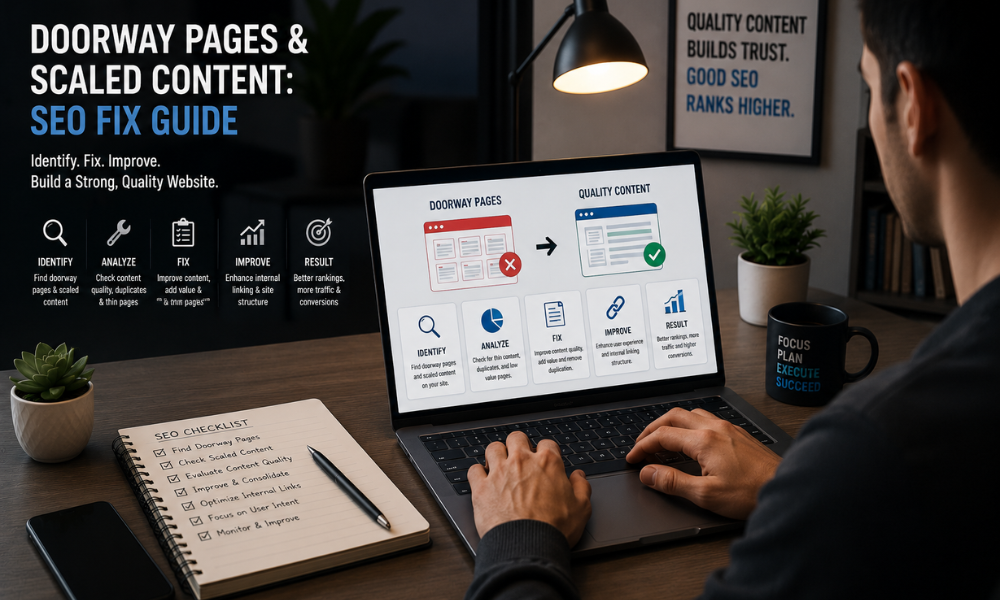
Doorway Pages and Scaled Content: How to Identify and Fix SEO Quality Issues
Introduction
Creating more content can help a website reach a wider audience, but publishing a large number of similar or low-value pages can create SEO problems. Doorway pages and scaled content are two important areas website owners should understand when working on search visibility and website quality.
Having hundreds of pages does not automatically mean better rankings. Search engines focus on whether a page provides useful, original, and relevant information to visitors. Pages created mainly to capture search traffic without offering enough value may negatively affect a website's search performance.
What Are Doorway Pages?
Doorway pages are pages created to rank for specific search queries or locations while providing little unique value to users. They often target similar keywords and eventually direct visitors toward the same destination.
For example, a business might create separate pages targeting :
- Best Digital Marketing Company in Chennai
- Best Digital Marketing Company in Coimbatore
- Best Digital Marketing Company in Madurai
- Best Digital Marketing Company in Salem
If each page contains almost identical content with only the city name changed, these pages may provide little additional value.
Location pages are not automatically doorway pages. If every location page contains genuinely useful, location-specific information, they can serve a legitimate purpose. The problem occurs when pages exist primarily to manipulate search rankings.
What Is Scaled Content?
Scaled content refers to producing a large amount of content through a repeatable process without giving enough attention to originality, usefulness, and quality.
This can happen through automated systems, templates, AI-assisted production, or even manual writing. The main concern is not simply how the content was created. What matters is whether the final content provides meaningful value to users.
Common examples include :
- Hundreds of pages with nearly identical text
- Automatically generated articles with little original information
- Keyword-based pages created mainly to attract search traffic
- Product or service pages with minimal differences
- Location pages where only the location name changes
How to Identify Doorway Pages
Finding doorway pages starts with reviewing your website's content structure.
Look for pages that :
- Target very similar keywords.
- Have almost identical content.
- Offer little unique information.
- Exist mainly to rank for different search terms.
- Send visitors to the same final destination.
- Do not provide a useful experience independently.
A content audit can help identify these patterns. Google Search Console and website crawling tools can also help you find pages with overlapping keywords, low traffic, or similar content.
How to Identify Scaled Content Issues
Scaled content problems can be harder to identify because a website may have many pages that appear different at first glance.
Check whether your content contains :
- Repeated introductions
- Repeated headings and paragraphs
- Excessive keyword usage
- Generic information
- Little original research or practical information
- Pages that do not satisfy search intent
- Automatically generated text with minimal human editing
If removing a keyword or changing a location name makes multiple pages almost identical, those pages need a closer review.
How Doorway Pages and Scaled Content Affect SEO
Low-quality pages can create several SEO challenges. When multiple pages target the same search intent, search engines may have difficulty determining which page should rank.
This can contribute to keyword cannibalization, weaker page relevance, poor user engagement, and inefficient crawling of a website.
Publishing large volumes of low-value content simply to gain search visibility can also create problems under Google's search spam policies.
The better approach is to create pages because users need them, rather than creating a separate page for every possible keyword variation.
How to Fix Doorway Pages
Start by identifying pages that have overlapping purposes.
If two pages serve the same search intent, consider combining them into one stronger resource. When appropriate, redirect the weaker URL to the most relevant page.
For genuinely useful location or service pages, add unique information such as:
- Local services
- Specific customer needs
- Relevant examples
- Unique FAQs
- Local expertise
- Useful images or resources
- Clear service information
Every page should have a clear reason to exist independently.
How to Fix Scaled Content Problems
The first step is to perform a complete content audit. Group pages according to topic, keyword, search intent, and quality.
Pages with useful information but weak writing can be improved. Pages with substantial duplicate or unnecessary content can be consolidated, redirected, or removed when appropriate.
Focus on creating content that demonstrates genuine knowledge and answers the questions users actually have.
Best Practices for High-Quality SEO Content
A stronger SEO strategy focuses on quality rather than publishing volume.
Follow these practices:
- Understand search intent before creating a page.
- Give every page a clear purpose.
- Avoid unnecessary keyword variations.
- Write original and useful information.
- Add relevant examples and practical details.
- Remove outdated or unnecessary pages.
- Use internal links naturally.
- Review automatically generated content before publishing.
- Regularly audit your website for duplicate and thin content.
Frequently Asked Questions :
Doorway pages can be problematic when they are created mainly to manipulate search rankings and provide little independent value to visitors.
No. Producing content at scale is not automatically a problem. The concern is scaled production that results in low-quality content created primarily to manipulate search rankings.
Not always. First evaluate their purpose, traffic, backlinks, and usefulness. Some pages can be improved or consolidated, while others may be better removed.
Yes. Location pages can be useful when each page provides genuinely relevant and unique information for that location.
A regular content audit every few months is useful, especially for websites that publish content frequently or have a large number of URLs.