

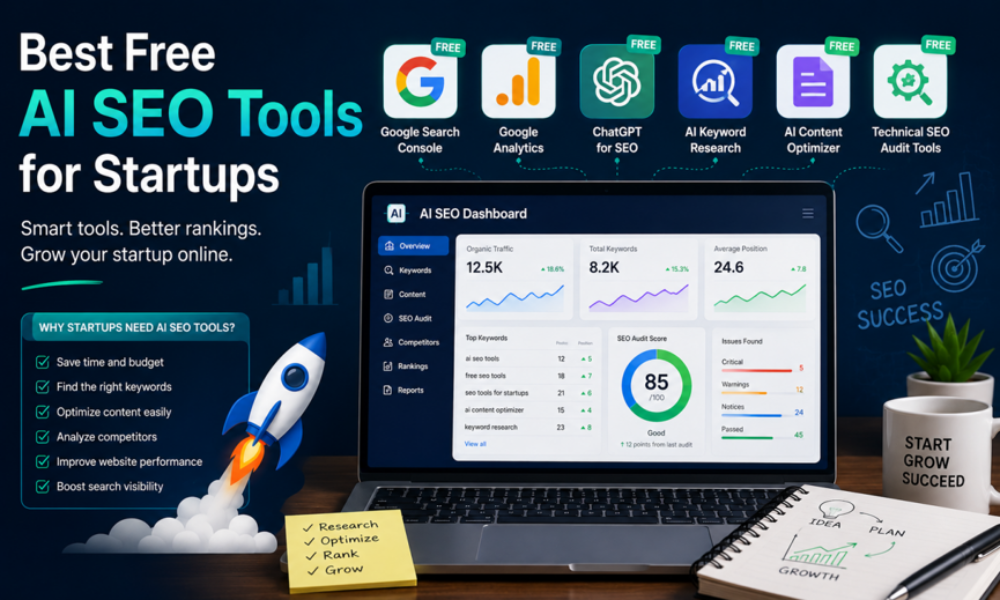
Best Free AI SEO Tools for Startups
Starting a business often means working with limited budgets, small teams, and many marketing responsibilities. SEO can be one of the most effective ways for startups to build long-term online visibility, but professional SEO platforms can sometimes be expensive for a new business.
Fortunately, the growth of artificial intelligence has introduced a wide range of tools that can support SEO research, content planning, website analysis, and optimization. Many platforms offer free features or limited free plans that can be useful for startups before they invest in advanced SEO software.
The best free AI SEO tools for startups can help simplify repetitive tasks, identify opportunities, and make SEO decisions more data-driven. However, the tools should support a clear strategy rather than replace human research and decision-making.
Why Startups Should Use AI SEO Tools
Startups need to make the most of every marketing activity. SEO can require significant research, including keyword discovery, competitor analysis, content planning, technical auditing, and performance monitoring.
AI can help reduce the time spent on some of these tasks.
For example, an AI-assisted SEO tool can help a startup :
- Discover relevant keyword ideas
- Group related search terms
- Generate content topic ideas
- Identify potential technical SEO issues
- Analyze competitors
- Improve existing content
- Understand search intent
- Find opportunities for website optimization
The biggest advantage is efficiency. Instead of spending hours organizing information manually, marketers can use AI to process data and create a starting point for further analysis.
What Should Startups Look for in a Free AI SEO Tool?
Not every free SEO platform offers the same features. Startups should choose tools based on their actual SEO requirements.
Important features to consider include :
Keyword Research
The tool should help discover relevant keywords, related searches, and potential content opportunities.
Content Optimization
AI can help evaluate content structure, topic coverage, headings, readability, and related concepts.
Technical SEO Analysis
A useful tool should provide information about technical issues such as broken links, crawlability, metadata, indexing, and page performance.
Competitor Research
Competitor analysis can help startups understand which topics and keywords similar businesses are targeting.
Reporting
Clear reports make it easier to track changes and understand whether SEO efforts are producing results.
Startups do not necessarily need a platform that provides every feature. A combination of free tools can often cover the most important SEO activities.
1. Google Search Console
Google Search Console is one of the most valuable free resources for website owners.
Although it is not exclusively an AI SEO platform, it provides important first-party information about how Google Search interacts with a website.
Startups can use it to understand :
- Search queries generating impressions
- Pages receiving clicks
- Average search positions
- Indexing problems
- Mobile usability
- Search performance trends
The data can also provide useful input for AI-assisted SEO analysis. For example, startups can identify keywords where their pages receive impressions but few clicks and then investigate whether the title and description need improvement.
2. Google Analytics
Google Analytics can help startups understand how visitors interact with their websites.
It can provide insights into:
- Traffic sources
- User engagement
- Landing pages
- Conversions
- Audience behavior
- Website performance
When combined with SEO data, analytics can help determine whether organic traffic is contributing to meaningful business results.
AI can then be used to organize or interpret datasets and identify trends that deserve further investigation.
3. ChatGPT for SEO Research and Content Planning
AI assistants such as ChatGPT can support many parts of an SEO workflow.
Startups can use an AI assistant for tasks such as:
- Generating content topic ideas
- Creating keyword clusters
- Understanding search intent
- Developing article outlines
- Finding potential FAQ topics
- Improving content structure
- Reviewing existing copy
- Creating content briefs
However, AI-generated information should always be checked for accuracy and relevance.
Instead of asking AI to produce an entire article without review, startups can use it as a research and planning assistant. Human editing and subject expertise remain important for creating genuinely useful content.
4. Free AI Keyword Research Tools
Keyword research is one of the foundations of SEO.
Several SEO platforms provide free keyword research features, although their free plans may limit the number of searches or available data.
AI-powered keyword research can help startups discover:
- Long-tail keywords
- Related terms
- Question-based searches
- Topic clusters
- Search intent variations
- Keyword opportunities
Long-tail keywords can be particularly useful for startups because highly specific searches may be less competitive than broad industry terms.
For example, instead of immediately targeting a broad phrase such as "digital marketing," a startup may find more focused opportunities related to a specific service, location, audience, or problem.
5. AI Content Optimization Tools
Creating content is only one part of an SEO strategy. Existing content also needs to be reviewed and improved.
AI content optimization tools can help analyze whether an article covers important concepts related to its main topic.
They may assist with :
- Heading structure
- Keyword variations
- Related topics
- Content depth
- Readability
- Search intent
- Internal linking opportunities
The objective should not be to add keywords simply because an AI tool recommends them.
Instead, startups should determine whether the suggested topic genuinely improves the usefulness of the page.
6. Free Technical SEO Audit Tools
Technical problems can prevent search engines from efficiently crawling and understanding a website.
Free auditing tools can help identify potential problems involving :
- Broken links
- Missing metadata
- Duplicate content
- Redirects
- Page status codes
- Crawlability
- Sitemap issues
- Mobile performance
AI can make these reports easier to interpret by organizing large numbers of findings into categories.
However, technical changes should be implemented carefully. A recommendation that looks simple in an automated report may require developer review before being changed.
7. AI Tools for Competitor Analysis
Understanding competitors can help startups identify opportunities that they may have missed.
AI-assisted competitor analysis can help examine :
- Competitor keywords
- Blog topics
- Content structure
- Search visibility
- Backlink opportunities
- Frequently covered subjects
The purpose of competitor research should not be to copy another company's content.
Instead, startups can use competitor insights to identify gaps and create content that is more useful, more specific, or better aligned with their audience.
8. AI Tools for Content Gap Analysis
Content gap analysis helps identify subjects that a website does not cover adequately.
AI can compare existing website content with related topics and competitor coverage to identify potential gaps.
For example, a startup offering website development services may have pages about web design but lack useful resources covering :
- Website maintenance
- Website security
- Core Web Vitals
- Mobile optimization
- Website accessibility
- Website performance
These gaps can become opportunities for future content.
How Startups Can Build an AI SEO Workflow
Using many tools without a clear process can create unnecessary work. A simple workflow can make AI-assisted SEO more effective.
Step 1: Define Your Target Audience
Understand who your customers are and what problems they are trying to solve.
Step 2: Research Keywords
Find relevant keywords and group them according to topics and search intent.
Step 3: Analyze Competitors
Review competing websites to understand their content coverage and identify potential gaps.
Step 4: Create a Content Plan
Use keyword and competitor insights to develop useful content topics.
Step 5: Optimize Existing Pages
Review important pages and improve content quality, structure, internal linking, and relevant metadata.
Step 6: Check Technical SEO
Run regular website audits to identify technical issues that could affect crawling or user experience.
Step 7: Measure Results
Monitor impressions, clicks, rankings, organic traffic, engagement, and conversions.
This process creates a continuous SEO cycle rather than treating SEO as a one-time project.
Are Free AI SEO Tools Enough for a Startup?
For an early-stage startup, free tools can provide a strong foundation. They can support keyword research, content planning, website monitoring, technical checks, and performance analysis without requiring a large software budget.
However, free tools often have limitations. Data access, search volume, competitor research, reporting, automation, and historical information may be restricted.
As the startup grows, investing in more advanced SEO platforms may become worthwhile if the additional data and automation can save time or improve decision-making.
The important point is to choose tools based on actual business requirements rather than paying for expensive software simply because it has more features.
Common Mistakes When Using AI SEO Tools
AI can make SEO more efficient, but poor usage can reduce content quality.
Startups should avoid :
- Publishing unedited AI-generated articles
- Repeating the same keywords unnaturally
- Copying competitor content
- Creating pages only to target search terms
- Trusting automated recommendations without verification
- Ignoring search intent
- Focusing only on rankings
- Publishing large volumes of low-value content
Search engines and users both benefit from content that is useful, accurate, original, and relevant.
AI should help improve the process, not encourage businesses to produce content simply for the sake of publishing.
Conclusion
The best free AI SEO tools for startups can provide valuable support without requiring a large marketing budget. From keyword research and content planning to technical audits and competitor analysis, AI can help small teams complete SEO tasks more efficiently.
Tools such as Google Search Console, Google Analytics, AI assistants, free keyword research platforms, content optimization tools, and technical auditing solutions can form a practical SEO toolkit for an early-stage business.
The key is to use these tools strategically. AI should assist with research, analysis, organization, and optimization while people remain responsible for accuracy, creativity, strategy, and final decisions.
With a consistent approach, startups can use free and AI-powered SEO resources to build stronger content, improve website visibility, understand their audience, and create a foundation for sustainable organic growth.
Frequently Asked Questions :
The best tools depend on a startup's needs, but useful free resources include Google Search Console, Google Analytics, free keyword research platforms, AI writing and research assistants, technical SEO audit tools, and content optimization platforms with free features.
Yes. Basic AI SEO tools can help startups perform research and understand common SEO opportunities. However, professional guidance can be valuable when dealing with technical SEO, competitive markets, website migrations, or complex optimization strategies.
Free SEO tools can provide useful information, but their data and features may be limited. Startups should compare important findings across reliable sources and use human judgment before making significant SEO decisions.
AI can assist with research, outlines, topic ideas, and content improvements. However, automatically publishing unreviewed content is not recommended. Human editing, fact-checking, originality, and audience relevance are important for high-quality SEO content.
SEO monitoring can be performed regularly, while deeper audits and content reviews can be scheduled periodically. The frequency depends on website size, publishing activity, competition, and how frequently the website changes.