

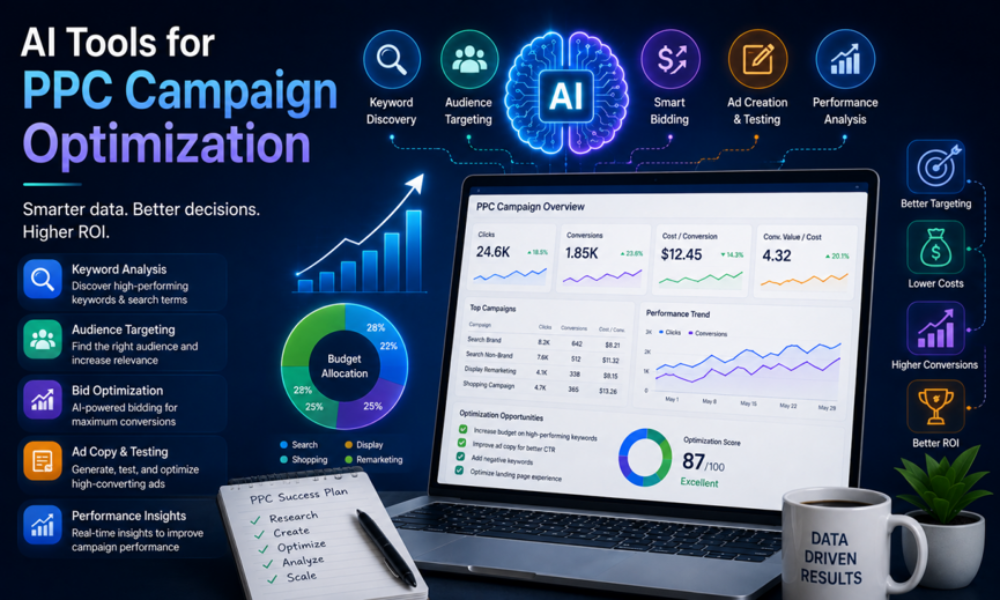
AI Tools for PPC Campaign Optimization
Pay-per-click advertising can provide businesses with a fast way to reach potential customers through search engines and other digital advertising platforms. However, managing PPC campaigns effectively requires continuous monitoring, keyword research, audience analysis, bid adjustments, ad testing, and budget management.
As advertising accounts become larger and more competitive, manually reviewing every campaign detail can become difficult. This is where artificial intelligence can provide valuable support.
AI tools for PPC campaign optimization can analyze large amounts of advertising data, identify patterns, suggest improvements, automate repetitive tasks, and help marketers make more informed decisions. When used correctly, AI can improve campaign efficiency while allowing marketing teams to spend more time on strategy and creative development.
What Is PPC Campaign Optimization?
PPC campaign optimization is the ongoing process of improving paid advertising campaigns to achieve better results from the available budget.
Depending on the campaign objective, optimization may focus on:
- Increasing qualified traffic
- Improving conversion rates
- Reducing unnecessary spending
- Improving ad relevance
- Finding better keywords
- Reaching the right audience
- Improving return on ad spend
- Increasing lead or sales volume
PPC optimization is not a one-time activity. Search behavior, competition, costs, audiences, and campaign performance can change over time. Regular analysis is therefore important.
How AI Is Changing PPC Management
Traditional PPC management often involves reviewing reports, comparing keywords, adjusting bids, analyzing search terms, and testing advertisements manually.
AI can assist with many of these activities by processing data much faster than a person can.
An AI-powered PPC workflow can help marketers identify :
- Underperforming keywords
- High-performing search terms
- Budget allocation opportunities
- Audience patterns
- Ad performance differences
- Conversion trends
- Potential bidding opportunities
- Campaign anomalies
The purpose is not to allow AI to make every advertising decision automatically. Instead, AI can provide insights that help marketers make better decisions.
1. AI Helps With Keyword Analysis
Keywords are central to search advertising. Choosing irrelevant or overly broad keywords can result in wasted advertising spend.
AI tools can analyze keyword performance and identify patterns across large keyword sets.
They can help marketers evaluate :
- Search terms
- Keyword relevance
- Conversion performance
- Cost per click
- Click-through rate
- Cost per conversion
- Negative keyword opportunities
For example, if a keyword generates many clicks but very few qualified leads, an AI-assisted analysis may highlight it as a candidate for review.
AI can also help identify related search terms that may be worth testing.
2. Improving Audience Targeting
Reaching the right audience is essential for PPC performance.
AI can analyze campaign and audience data to identify patterns in user behavior. Depending on the advertising platform and available data, marketers may discover differences between audiences based on factors such as location, device, interests, behavior, or previous interactions.
These insights can help businesses adjust their targeting strategy.
For example, if one audience segment consistently produces higher-quality leads than another, marketers may decide to allocate more of the available budget toward that segment.
Audience decisions should still be reviewed carefully because historical performance does not always guarantee future results.
3. AI-Powered Bid Optimization
Bid management can become complicated when a business runs multiple campaigns, ad groups, keywords, and locations.
AI-based bidding systems can analyze historical and real-time signals to determine how bids may be adjusted according to campaign objectives.
Depending on the platform, automated bidding may consider signals such as :
- Device
- Location
- Time
- Search context
- Audience characteristics
- Previous interactions
- Conversion likelihood
The goal is to use the available budget efficiently rather than simply increasing bids across the entire campaign.
However, automated bidding works best when conversion tracking is accurate and sufficient performance data is available.
4. Improving Ad Copy With AI
Ad copy has a direct influence on whether users decide to click an advertisement.
AI tools can help marketers develop different headline and description ideas based on a campaign's target audience and messaging.
AI can assist with:
- Headline variations
- Description ideas
- Calls to action
- Benefit-focused messaging
- Promotional variations
- Different value propositions
For example, a company offering software services might test different messages focused on price, productivity, ease of use, or business outcomes.
AI can generate variations quickly, but marketers should review every advertisement to ensure that the claims are accurate and consistent with the brand.
5. AI Helps With Ad Testing
Testing different advertisements is an important part of PPC optimization.
Instead of relying on one advertisement, marketers can test multiple variations to understand which messaging performs better.
AI can help organize and compare ad performance based on metrics such as:
- Impressions
- Click-through rate
- Conversion rate
- Cost per conversion
- Conversion value
- Engagement
The results can then guide future creative decisions.
AI should not simply select an ad based on clicks. A high click-through rate does not necessarily mean that an advertisement is generating valuable customers. Conversion quality and business outcomes should also be considered.
6. Detecting Campaign Performance Changes
Advertising campaigns can sometimes experience sudden changes in performance.
For example, clicks may decline, costs may increase, or conversions may suddenly drop.
AI-powered monitoring systems can help detect unusual changes more quickly.
Potential issues may include:
- Sudden increases in cost
- Declining conversion rates
- Reduced traffic
- Unusual spending
- Changes in keyword performance
- Tracking problems
Early detection gives marketers an opportunity to investigate the cause before a small problem becomes a major budget issue.
7. Budget Allocation
One of the most important PPC decisions is determining where the advertising budget should be spent.
AI can analyze campaign performance and identify areas that are producing stronger results.
For example, a business may discover that one campaign generates a significantly better conversion rate than another. This information can support a discussion about whether the budget should be redistributed.
Budget decisions should consider more than one metric. Revenue, lead quality, customer value, conversion rates, and business goals should all be taken into account.
8. AI Helps Analyze PPC Reports
PPC platforms can generate large amounts of performance data.
For smaller teams, interpreting these reports can be time-consuming.
AI tools can help summarize important changes and organize information into understandable insights.
For example, an AI-assisted reporting system might help identify :
- Which campaigns improved
- Which campaigns declined
- Which keywords changed significantly
- Where costs increased
- Which landing pages produced better conversions
- Which audiences performed differently
This can make regular PPC reporting more efficient.
9. Improving Landing Page Performance
PPC optimization does not stop at the advertisement.
A user who clicks an ad expects to find relevant and useful information on the landing page. If the landing page is confusing, slow, or unrelated to the advertisement, advertising performance can suffer.
AI tools can assist with landing page analysis by reviewing areas such as:
- Content relevance
- Page structure
- Calls to action
- User experience
- Content clarity
- Mobile usability
- Conversion opportunities
The landing page should deliver on the promise made in the advertisement.
For example, if an advertisement promotes a specific service, the landing page should clearly explain that service rather than sending visitors to a generic homepage.
10. Finding Negative Keyword Opportunities
Negative keywords help prevent advertisements from appearing for irrelevant searches.
AI can analyze search-term data and identify queries that may be wasting budget.
For example, if a business sells premium professional services, searches containing terms associated with free or unrelated products might not be useful.
Reviewing search-term patterns can help marketers identify potential negative keywords.
However, automated recommendations should always be checked because some search terms may look irrelevant but still generate valuable conversions.
Best Practices for Using AI in PPC Optimization
AI can be powerful, but results depend on how it is used.
Businesses should follow several best practices.
Set Clear Campaign Objectives
Define whether the campaign is focused on leads, sales, traffic, awareness, or another business outcome.
Maintain Accurate Conversion Tracking
AI-driven recommendations are only as useful as the data they receive. Incorrect conversion tracking can lead to poor decisions.
Review Automated Recommendations
Do not accept every AI recommendation without checking its relevance and potential impact.
Test Changes Gradually
Make controlled changes whenever possible so that performance can be measured accurately.
Focus on Business Outcomes
Look beyond clicks and impressions. Consider qualified leads, sales, revenue, customer value, and return on advertising investment.
Common Mistakes to Avoid
Using AI incorrectly can create new problems.
Businesses should avoid:
- Automatically applying every AI recommendation
- Generating generic ad copy
- Ignoring conversion quality
- Using inaccurate tracking data
- Increasing budgets without sufficient evidence
- Targeting audiences too broadly
- Focusing only on click-through rates
- Making too many changes simultaneously
AI should support a structured PPC strategy rather than replace strategic thinking.
AI and Human Expertise Work Better Together
AI is excellent at processing data, identifying patterns, and automating repetitive tasks. Human marketers are better positioned to understand brand positioning, customer psychology, business goals, market conditions, and creative messaging.
Combining both capabilities creates a more balanced approach.
AI can answer questions such as:
- What changed?
- Where is performance improving?
- Which keywords need attention?
- Which campaigns are spending inefficiently?
- What patterns appear in the data?
Marketing professionals can then determine:
- Why the change happened
- Whether it matters to the business
- What action should be taken
- How the brand should communicate
- Which strategy should be tested next
Conclusion
AI tools for PPC campaign optimization can help businesses manage paid advertising more efficiently by supporting keyword analysis, audience targeting, bid management, ad testing, performance monitoring, budget allocation, and reporting.
The biggest advantage of AI is its ability to process large amounts of data and identify patterns that may take considerable time to find manually.
However, AI should not operate without human oversight. Accurate conversion tracking, clear campaign goals, thoughtful testing, and professional judgment remain essential for successful PPC management.
When AI technology and human expertise are combined, businesses can build a more efficient PPC optimization process, reduce unnecessary manual work, make data-driven decisions, and work toward stronger advertising performance and long-term growth.
Frequently Asked Questions :
AI PPC tools use artificial intelligence and automation to analyze advertising data, identify performance patterns, assist with bidding, keyword research, ad testing, audience analysis, and campaign optimization.
AI can help identify inefficient spending, improve targeting, optimize bids, and highlight underperforming keywords. However, cost reduction is not guaranteed and depends on campaign quality, competition, tracking accuracy, and the optimization strategy.
Yes. AI can generate headline, description, and messaging variations for PPC campaigns. However, marketers should review the content to ensure that it is accurate, persuasive, brand-consistent, and compliant with advertising policies.
AI can analyze keyword and search-term performance to identify relevant opportunities, underperforming keywords, search patterns, and potential negative keywords. These recommendations should be reviewed before changes are made.
Complete automation is not ideal for every business. AI can handle many repetitive tasks and provide useful recommendations, but human oversight is important for budget decisions, strategy, creative direction, conversion quality, and overall campaign management.