

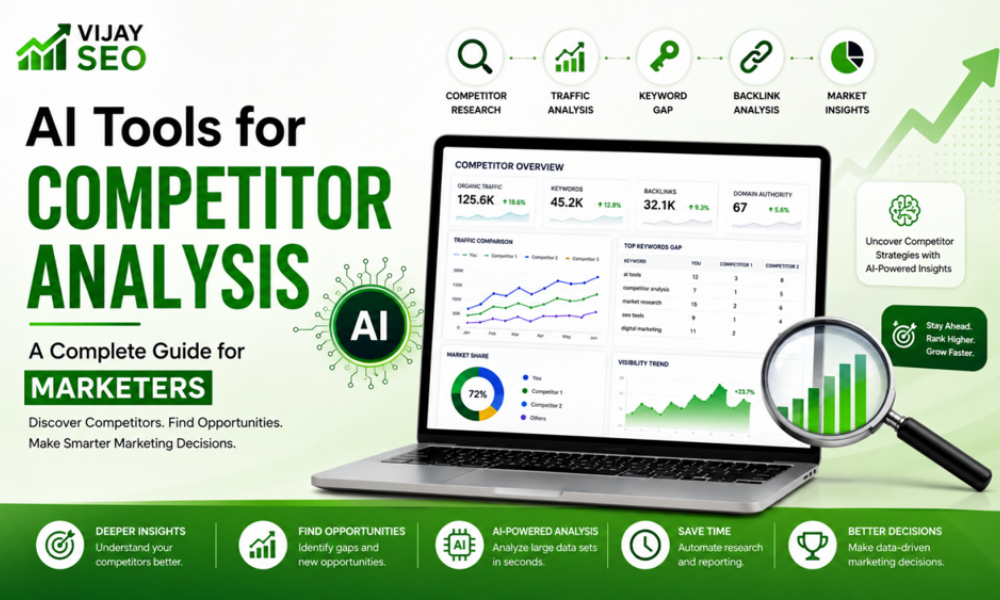
AI Tools for Competitor Analysis - A Complete Guide for Marketers
In today’s competitive digital landscape, businesses need more than a great product or service to succeed. Understanding what competitors are doing, how they attract customers, which keywords they target, and where their online strategies are stronger or weaker can provide a major advantage. This is where AI Tools for Competitor Analysis can make a significant difference.
Traditional competitor analysis often involves manually checking websites, researching keywords, monitoring social media, reviewing content, and comparing backlinks. This process can take hours or even days. Modern AI competitor analysis tools can automate much of this work, identify patterns in large datasets, and provide actionable insights much faster.
Whether you are an SEO professional, digital marketer, business owner, content strategist, or startup founder, using the right AI tools for competitor research can help you make smarter marketing decisions and discover opportunities that may otherwise be overlooked.
What Is Competitor Analysis?
Competitor analysis is the process of researching businesses that compete with your brand to understand their strategies, strengths, weaknesses, content, marketing activities, and online visibility.
A comprehensive competitive analysis may include:
- Website and content analysis
- Competitor keyword research
- Search engine ranking comparison
- Backlink analysis
- Social media monitoring
- Content gap identification
- Paid advertising research
- Traffic and audience analysis
- Product and service comparison
- Brand positioning analysis
When AI is added to this process, marketers can analyze large amounts of information more efficiently and identify meaningful patterns.
Why Use AI Tools for Competitor Analysis?
Manual research is still useful, but it becomes difficult when you are tracking several competitors across multiple platforms. AI-powered competitor analysis can simplify repetitive tasks and help marketers focus on strategy rather than data collection.
1. Faster Research
AI tools can process large volumes of information quickly. Instead of manually visiting dozens of competitor pages, marketers can use AI competitor research tools to collect and organize information in less time.
2. Better Keyword Insights
Finding the keywords competitors rank for is an important part of SEO. AI keyword analysis tools can help identify high-value search terms, related keywords, content opportunities, and potential gaps in your current strategy.
3. Content Gap Discovery
A competitor may rank for topics that your website has not covered yet. AI can compare content and help identify content gaps that could become opportunities for new blog posts, landing pages, guides, or resource pages.
4. Improved Decision-Making
Instead of relying only on assumptions, businesses can use data-driven insights. AI marketing tools can help identify trends and provide information that supports better decisions.
5. Continuous Monitoring
Competitor strategies change regularly. New content is published, rankings move, advertisements change, and businesses launch new campaigns. AI-based platforms can make competitor monitoring> more efficient.
Best AI Tools for Competitor Analysis :
There are many platforms that combine AI, SEO data, competitive intelligence, and automation. The best option depends on the type of analysis you need.
| AI Tool | Best For | Key Competitor Analysis Feature |
|---|---|---|
| Semrush | SEO & competitive research | Keywords, backlinks, traffic insights and competitor domains |
| Ahrefs | SEO research | Backlinks, keywords, content and ranking analysis |
| Similarweb | Market research | Traffic sources, audience and industry insights |
| SpyFu | Competitor keyword research | Organic and paid keyword analysis |
| SE Ranking | SEO monitoring | Competitor rankings, keywords and website comparison |
| BuzzSumo | Content research | Competitor content and social engagement analysis |
| Surfer | Content optimization | Content comparison and SEO recommendations |
| ChatGPT | Research & strategy | Competitor data analysis, summaries and strategic brainstorming |
These platforms have different strengths. Some focus primarily on SEO, while others are designed for content intelligence, traffic research, or broader market analysis.
How AI Helps With Competitor Keyword Research:
Competitor keyword research is one of the most valuable areas where AI can support digital marketing.
Suppose a competitor is consistently ranking for a particular group of search queries. Instead of checking each keyword manually, an AI SEO tool can help organize related terms and identify themes.
Marketers can look for:
- High-ranking competitor keywords
- Long-tail search terms
- Related questions
- Commercial keywords
- Informational keywords
- Keyword gaps
- Low-competition opportunities
- Content topics with strong search intent
The goal should not be to copy a competitor's keyword strategy. Instead, use the information to understand what users are searching for and create more useful content.
Using AI for Competitor Content Analysis:
Content is another important area of competitive analysis.
AI can help marketers compare competitor blogs, landing pages, product pages, guides, and other content assets. You can examine factors such as topic coverage, content structure, search intent, headings, frequently discussed questions, and potential content gaps.
For example, if several competitors have published articles about a particular topic but none provide detailed examples, original research, practical steps, or updated information, that may represent an opportunity.
A strong competitor content analysis should focus on creating something genuinely more useful rather than simply producing a longer version of an existing article.
AI for Competitor Backlink Analysis:
Backlinks continue to play an important role in SEO. Analyzing competitor backlink profiles can reveal websites, publications, directories, blogs, and other platforms that link to competing businesses.
With AI backlink analysis, marketers can organize backlink data and identify patterns.
You can investigate:
- Which websites link to competitors
- Which competitor pages attract backlinks
- What types of content earn links
- Which industry websites are active
- Potential link-building opportunities
- Competitor link growth over time
However, not every backlink is worth pursuing. Quality, relevance, authority, and editorial value should be considered before building links.
AI-Powered Competitor Social Media Analysis:
Competitor research should not stop with search engines. Social media can reveal how competing brands communicate with their audiences.
AI social media analysis can help identify frequently discussed topics, popular content formats, audience engagement patterns, posting themes, and potential content opportunities.
You might discover that competitors receive strong engagement from:
- Educational videos
- Customer stories
- Short-form content
- Industry insights
- Product demonstrations
- Infographics
- Frequently asked questions
These insights can help your brand develop a stronger social media strategy while maintaining its own identity.
How to Choose the Right AI Competitor Analysis Tool:
The right tool depends on your business objectives. Before subscribing to a platform, determine what type of competitor research you actually need.
SEO Requirements :
If your primary goal is competitor SEO analysis, choose a platform with strong keyword, backlink, ranking, and domain research capabilities.
Content Requirements :
If content marketing is your main focus, look for tools that provide competitor content analysis, topic research, content gaps, and search-intent insights.
Market Research :
For broader industry research, platforms that provide traffic, audience, market, and industry data may be more appropriate.
Ease of Use :
A powerful tool is only valuable when your team can use it effectively. Choose an interface that makes data easy to understand and act upon.
Integration :
If you already use SEO, analytics, content, or reporting platforms, check whether the tool integrates with your existing workflow.
A Simple AI Competitor Analysis Process :
You do not need an extremely complicated process to get started. A simple workflow can produce useful insights.
Step 1: Identify Your Competitors
Create a list of direct and indirect competitors. Include businesses competing for the same customers and search terms.
Step 2: Collect Competitor Data
Use AI competitor analysis tools to examine keywords, content, backlinks, rankings, traffic sources, and other relevant information.
Step 3: Find Gaps
Look for areas where competitors are performing well but your website has limited visibility.
Step 4: Prioritize Opportunities
Not every opportunity deserves immediate attention. Focus on keywords, topics, channels, and strategies that align with your business goals.
Step 5: Create Better Strategies
Use the findings to improve your content plan, SEO strategy, link-building approach, and overall digital marketing activities.
Step 6: Monitor Changes
Competitor research should be ongoing. Track important changes and update your strategy as the market evolves.
Pro Tip :
Don't use AI Tools for Competitor Analysis simply to copy what other businesses are doing. Use AI to identify patterns, gaps, customer needs, and opportunities. The strongest strategy combines competitor data with your own audience research, original ideas, expertise, and brand positioning.
Common Mistakes to Avoid :
While AI can make competitor analysis faster, there are still several mistakes marketers should avoid.
Copying Competitor Content :
Competitor research should inspire strategy, not plagiarism. Create original content that adds genuine value.
Focusing Only on Rankings :
Search rankings are important, but they are not the only measurement. Consider conversions, relevance, engagement, brand visibility, and customer experience.
Ignoring Search Intent :
A keyword may look attractive based on volume, but it may not match your audience's needs. Always consider search intent before creating content.
Using Too Much Data :
More data does not automatically mean better decisions. Focus on insights that can lead to specific actions.
Forgetting Human Judgment :
AI can process information quickly, but human expertise remains essential. Marketers need to interpret the findings and determine what makes sense for their business.
Future of AI in Competitor Analysis :
The role of AI in digital marketing is continuing to evolve. Future AI competitor analysis tools are likely to become more capable of understanding complex market signals, predicting changes, summarizing competitor movements, and connecting information from multiple marketing channels.
For businesses, this means competitor research can become more continuous rather than an occasional activity. Instead of performing a major competitor review once every few months, marketing teams can monitor important changes and respond more quickly.
However, successful competitive intelligence will still depend on the quality of the data and the ability to turn insights into practical strategies.
AI Tools for Competitor Analysis are becoming valuable resources for businesses that want to understand their market and improve their digital marketing strategies. From competitor keyword research and content gap discovery to backlink analysis, social media monitoring, and market research, AI can reduce manual work and make large amounts of information easier to analyze.
Tools such as Semrush, Ahrefs, Similarweb, SpyFu, SE Ranking, BuzzSumo, Surfer, and ChatGPT can support different parts of the research process. The best choice depends on your objectives, budget, workflow, and the type of competitive intelligence you need.
The key is to use AI as a research and decision-support resource rather than a replacement for human strategy. When competitor insights are combined with original content, audience understanding, creativity, and strong execution, businesses can discover new opportunities and build a more effective digital presence.
Frequently Asked Questions :
AI Tools for Competitor Analysis are software platforms that use artificial intelligence, automation, and data analysis to research competitors, keywords, content, backlinks, traffic, and marketing strategies.
The best tool depends on your objective. Semrush and Ahrefs are strong choices for SEO and competitor research, while Similarweb is useful for traffic and market insights, and BuzzSumo is valuable for content research.
Yes. AI competitor research tools can help identify keywords competitors rank for, keyword gaps, related search terms, and potential content opportunities.
AI can compare competitor content, identify common topics, analyze content structures, uncover gaps, and help marketers discover opportunities to create more useful and comprehensive content.
AI tools provide valuable data and insights, but they should not be the only part of an SEO strategy. Human expertise, audience research, search intent, content quality, technical SEO, and ongoing testing are also important.