

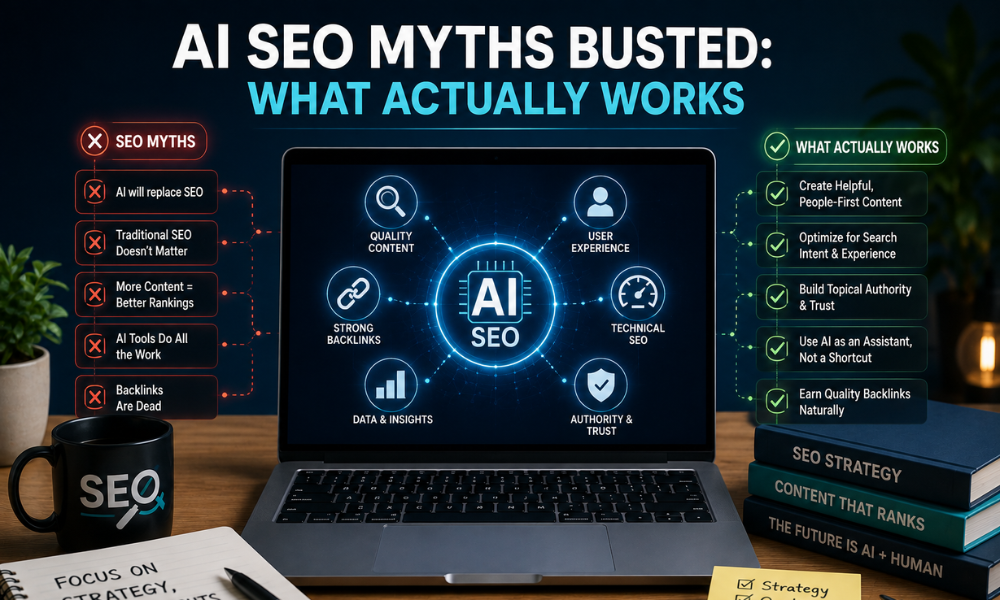
AI SEO Myths Busted: What Actually Works
As AI search grows, so does the amount of confusing, contradictory, and sometimes outright false advice about how to optimize for it. Some businesses are panicking unnecessarily, while others are ignoring real changes they should be paying attention to.
Let's separate fact from fiction. Here are the most common AI SEO myths — and what actually works instead.
Myth 1: "Traditional SEO Doesn't Matter Anymore"
The Truth: AI search tools still rely heavily on well-optimized, technically sound websites to generate their answers. Site speed, mobile-friendliness, crawlability, and quality backlinks remain foundational ranking factors — for both traditional search engines and AI models pulling information from the web.
What Actually Works: Keep investing in technical SEO and content quality as the base of your strategy, then layer AI-specific optimization on top.
Myth 2: "You Need Completely Different Content for AI SEO"
The Truth: AI SEO doesn't require an entirely separate content strategy. It requires better-structured, clearer versions of the same quality content search engines have always valued.
What Actually Works: Restructure existing content with direct answers, clear headings, and scannable formatting rather than creating entirely new, separate "AI-only" content.
Myth 3: "Keyword Research Is Obsolete Now"
The Truth: Keyword research has evolved, not disappeared. AI models still rely on understanding topics and intent, which keyword and query research helps identify.
What Actually Works: Shift keyword research toward topics, questions, and search intent, while still using data to prioritize which subjects deserve content investment.
Myth 4: "Stuffing Content With AI-Related Keywords Improves AI Visibility"
The Truth: Keyword stuffing — including stuffing AI-related terms — doesn't improve how AI models evaluate or cite content. AI systems prioritize clarity, accuracy, and genuine usefulness over keyword density.
What Actually Works: Focus on naturally answering user questions clearly and comprehensively, using relevant terms where they fit organically.
Myth 5: "AI Overviews Always Reduce Website Traffic"
The Truth: While some informational queries see reduced clicks due to AI Overviews, being cited as a source can also drive high-quality, trust-based traffic and brand visibility.
What Actually Works: Track both traditional traffic metrics and AI citation appearances to get a complete picture of your visibility, rather than assuming AI Overviews are purely negative.
Myth 6: "Only Big Brands Can Rank in AI Search Results"
The Truth: AI models prioritize clarity, structure, and trustworthiness — not just brand size. Small and local businesses with well-optimized, authoritative content can absolutely earn citations in AI-generated answers.
What Actually Works: Focus on demonstrating genuine expertise and clear, well-structured content rather than assuming only large competitors can succeed.
Myth 7: "Schema Markup Guarantees AI Citations"
The Truth: Schema markup helps AI models understand content more accurately, but it doesn't guarantee citation. Content quality, authority, and relevance still play major roles.
What Actually Works: Use schema markup as one part of a broader strategy that includes strong content, technical health, and authority-building — not a standalone fix.
Myth 8: "AI Search Optimization Is a One-Time Task"
The Truth: AI search algorithms and models are updated frequently, and citation patterns can shift as a result. Treating AI SEO as a "set it and forget it" task leads to declining visibility over time.
What Actually Works: Build AI SEO monitoring and content updates into your regular SEO routine, reviewing performance every few months.
Myth 9: "Blocking AI Crawlers Protects Your SEO"
The Truth: Blocking AI crawlers like GPTBot or Google-Extended may prevent your content from being used in AI training or citations, potentially reducing your visibility in AI-generated answers rather than protecting your rankings.
What Actually Works: Carefully evaluate the trade-offs before blocking AI crawlers, since doing so can limit your visibility in a growing share of search experiences.
Myth 10: "AI SEO and Traditional SEO Are Completely Separate Strategies"
The Truth: AI SEO builds directly on traditional SEO fundamentals. They share the same foundation — technical health, quality content, and authority — with AI SEO adding extra layers like structured data and answer-first formatting.
What Actually Works: Treat AI SEO as an extension of your existing SEO strategy, not a completely separate initiative requiring a different approach from scratch.
Quick Myth vs Fact Summary
| Myth | Fact |
|---|---|
| Traditional SEO doesn't matter | Traditional SEO remains the foundation |
| Need entirely different content | Same quality content, better structured |
| Keyword research is obsolete | Keyword research has evolved, not disappeared |
| Stuffing AI keywords helps | Clarity and accuracy matter more than density |
| AI Overviews always hurt traffic | Citations can drive high-quality traffic too |
| Only big brands can rank | Small businesses can earn AI citations too |
| Schema guarantees citations | Schema helps but doesn't guarantee results |
| AI SEO is one-time work | Requires ongoing monitoring and updates |
| Blocking AI crawlers protects SEO | Blocking can reduce AI visibility |
| AI SEO is a separate strategy | AI SEO extends traditional SEO fundamentals |
Frequently Asked Questions :
The idea that traditional SEO no longer matters. In reality, strong technical SEO and quality content remain the foundation AI search visibility is built upon.
No. Waiting too long can put businesses at a disadvantage compared to competitors who adapt early, especially as AI search continues to grow in usage.
Yes, to some extent. While core principles like clarity and structure remain stable, specific tactics may need adjustment as AI models and algorithms evolve.
Yes. Practices like keyword stuffing or unnecessarily blocking AI crawlers based on misconceptions can reduce both traditional and AI search visibility.
Regularly reviewing credible, updated industry resources and monitoring your own website's performance across both traditional rankings and AI citation appearances is the most reliable approach.